


search

December 9, 2025

The concept of mirroring patients virtually is moving from theory to practice in drug development. For years, researchers have relied on digital or Virtual Twin® modeling, or representations of patients that simulate how they might respond to a treatment, to inform trial design and dosing strategies. The next evolution is the virtual triplet, which pairs the Virtual Twin model with a biological counterpart, such as an organ-on-a-chip. Together, they create a continuous feedback loop between computer simulation and living human tissue.

Virtual triplets are opening new possibilities in areas where traditional approaches fall short. They enable smaller, more targeted trials in rare diseases and pediatrics, reduce reliance on animal models, and refine experimental therapies such as gene treatments before they ever reach a patient. Progress in this space is accelerating, and what once felt futuristic is closer than most realize.

The value of virtual models

Even with decades of progress and innovation in drug development, the path from discovery to approval remains long, costly, and uncertain. Traditional trials often face limits that slow advancement or leave critical questions unanswered, especially in rare diseases and pediatrics, where patient numbers are scarce and conventional designs may not be possible. Virtual models help close those gaps by allowing researchers to explore dosing strategies, drug combinations, and trial designs before moving into the clinic. The result is sharper decision-making and a lower risk of advancing programs unlikely to succeed.

Evidence from industry leaders illustrates the impact. Pfizer reported that systematic use of model-informed drug development shortened cycle times by an average of 10 months and reduced costs by $5 million per program. AstraZeneca’s retrospective analysis across more than a decade of compounds showed that incorporating mechanistic biosimulation more than doubled the probability of reaching proof-of-mechanism in the clinic.

~10 months shorter development cycle time per program

~US $5 million saved in clinical trial costs per program per year

~US$ 70 million per year cost-related efficiencies if MIDD is implemented in the first year

By using Model-Informed Drug Development (MIDD)

The study covers data from a “typical year between 2021 and 2023,” supporting broad applicability of these savings across a drug-development portfolio rather than just isolated cases. Source: https://ascpt.onlinelibrary.wiley.com/doi/10.1002/cpt.3636

The foundation of Virtual Twin technology

The path to virtual triplets follows the Virtual Twin modeling approaches behind them. In drug development, Virtual Twin models are built on two well-established methods: physiologically based pharmacokinetic (PBPK) modeling and quantitative systems pharmacology (QSP).

PBPK provides a mechanistic framework for predicting how a therapy may impact the body. By modeling processes such as absorption, distribution, metabolism, and excretion, PBPK can simulate how drugs perform across diverse populations and conditions. Researchers can explore questions that would be difficult or even impossible to test directly in a trial, such as “How would impaired kidney function alter clearance of a therapy?” or “What dose adjustments are needed for children compared to adults?”

QSP extends PBPK by integrating disease biology and drug’s mechanism of action. Instead of focusing solely on how a compound moves through the body, QSP connects molecular pathways and systems-level interactions to clinical outcomes. With this lens, researchers can ask deeper questions. For example, “If clearance is reduced in patients with kidney impairment, how does that affect biomarker changes or safety risk?” and “When dosing is adjusted for pediatric patients, how does the therapy alter disease progression over time?”

PBPK answers questions of exposure, while QSP predicts the response. Both approaches are supported by decades of validation, thousands of publications, and a growing body of regulatory precedent. The European Medicines Agency (EMA) has formally qualified PBPK modeling for predicting drug interactions, and the U.S. Food and Drug Administration (FDA) has encouraged the use of QSP in areas where direct testing is not possible.

Adding a biological twin

While PBPK and QSP provide the computational backbone of Virtual Twin modeling, organ-on-a-chip technology introduces a biological dimension. These micro-engineered systems mimic the structure and function of human tissues such as the liver, heart, lung, or gut, often derived from patient cells. With the ability to replicate physiology at a cellular level, they introduce a powerful alternative to traditional cell culture or animal models.

Organ-on-a-chip platforms allow researchers to measure drug response, toxicity, and biomarkers with greater fidelity to human biology. Their potential aligns directly with the FDA’s Novel Alternative Methods (NAMs) initiative, which is guiding the industry toward reducing its reliance on animal testing in preclinical research.

Early collaborations are already demonstrating practical applications for organ-on-a-chip platforms. For example, using a liver-on-a-chip, researchers can evaluate how gene therapy vectors express proteins in human tissue and translate those insights into dose predictions with PBPK and QSP models. When paired with computational modeling, organ-on-a-chip technology moves beyond an experimental tool and becomes an integrated part of development strategy.

Defining and applying virtual triplets

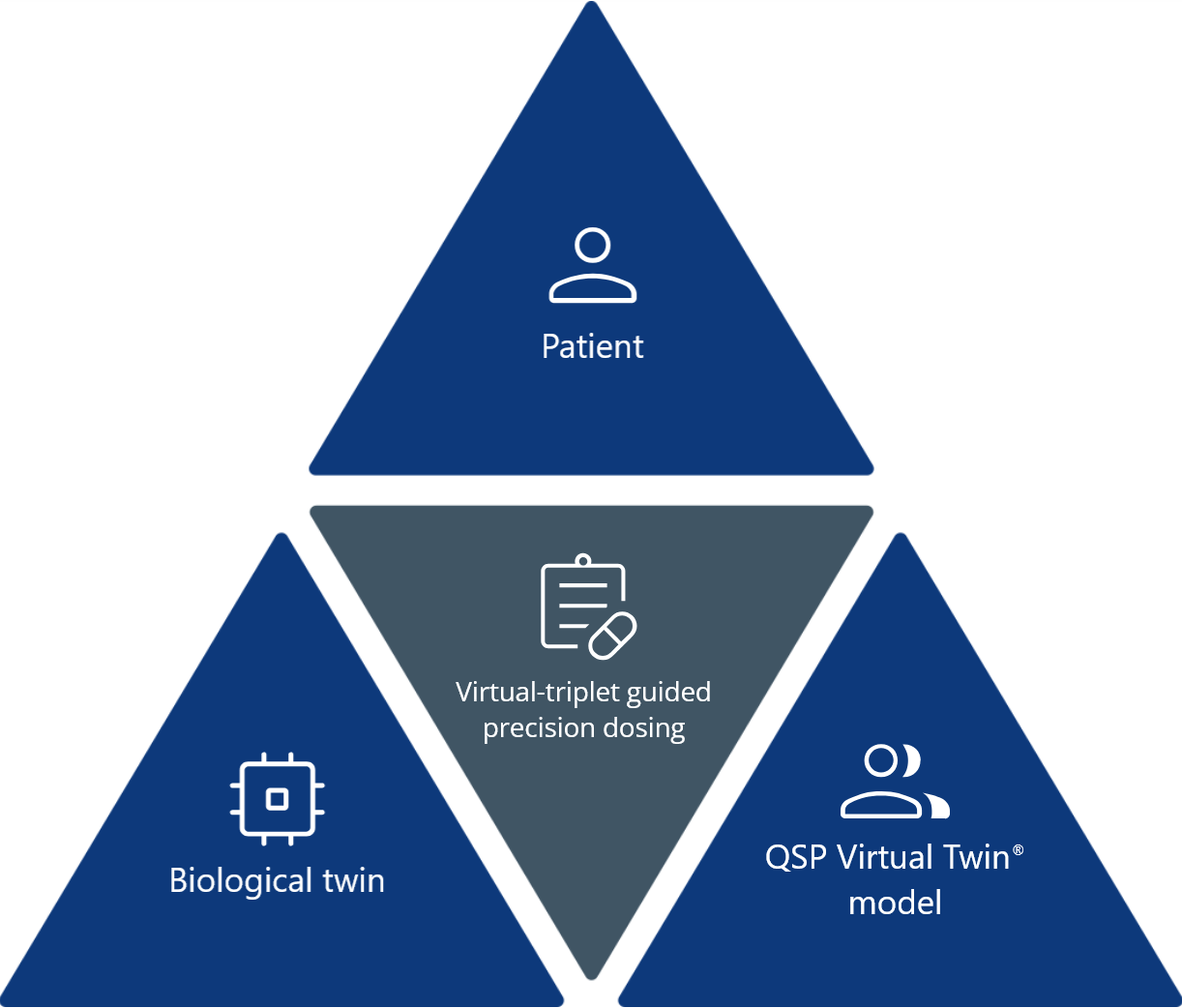
A virtual triplet connects three elements into a single framework:

  • The patient: An individual with unique biology.
  • The Virtual Twin models: Computational models such as PBPK and QSP.
  • The biological twin: An organ-on-a-chip derived from patient cells or engineered to replicate human physiology.

By integrating all three, researchers can run an iterative loop that continually improves predictions with each cycle. A therapy can be tested on the chip; the results inform the Virtual Twin model, and the model refines the dose and regimen for the patient. The cycle continues until an optimized strategy emerges.

Potential applications include:

  • Rare diseases and pediatrics: When only a handful of patients are available, virtual triplets can supplement scarce trial data with simulations and chip-based results, possibly generating stronger evidence for regulators and clinicians.
  • Gene therapy: Liver-on-a-chip models can reveal how a therapy expresses its target protein in human tissue, while PBPK and QSP translate those findings into accurate dosing strategies. In pediatrics, especially, where therapies may be given to infants only once, virtual triplets can provide critical confidence in getting the dose right the first time.
  • Oncology: QSP can model immuno-oncology combinations and tumor-on-a-chip platforms can add biological validation to refine regimens before they reach patients.
  • Neurodegenerative disease: In conditions like Alzheimer’s, Virtual Twin model development can serve as synthetic or external controls to reduce the need for large placebo cohorts, while organ-on-a-chip models provide additional biological context.

These are just a few examples illustrating how virtual triplets can potentially enable safer, faster, and more precise drug development.

The future of virtual triplets

It’s important to acknowledge that organ-on-a-chip technology is still in the early stages of widespread adoption. While the technology is sophisticated, challenges remain in scaling it to toxicology studies or capturing the complexity of whole-body interactions. Some therapeutic areas, such as immunology, present particular difficulties due to the intricacy of immune system dynamics.

That said, momentum is building. The FDA’s NAM initiative is driving industry focus, and technological progress in high-throughput, multi-organ platforms is accelerating. The vision of using virtual triplets in everyday clinical practice is not yet a reality, but it is not science fiction either. The foundation is laid down, the technology is advancing, and the regulatory environment is supportive.

At Certara, we see virtual triplets as the natural evolution of model-informed drug development. Through our PBPK and QSP products and ongoing work to integrate organ-on-a-chip data, we are helping to bring virtual triplets from idea to implementation. Explore how Certara’s modeling and simulation services can support your programs.

Piet van der Graaf, PharmD, PhD, Senior Vice President, Quantitative Systems Pharmacology at Certara
Piet van der Graaf, PharmD, PhD

Senior Vice President and Head of Quantitative Systems Pharmacology

Piet van der Graaf is Senior Vice President and Head of Quantitative Systems Pharmacology at Certara and Professor of Systems Pharmacology at Leiden University.  From 2013-2016 he was the Director of Research of the Leiden Academic Centre for Drug Research.  From 1999-2013 he held various leadership positions at Pfizer in Discovery Biology, Pharmacokinetics and Drug Metabolism and Clinical Pharmacology.  He was the founding Editor-in-Chief of CPT: Pharmacometrics & Systems Pharmacology from 2012-2018 before becoming Editor-in-Chief of Clinical Pharmacology & Therapeutics.  Piet received his doctorate training in clinical medicine with Nobel prize laureate Sir James Black at King’s College London.  He has been awarded the 2024 Gary Neil Prize for Innovation in Drug Development from the American Society of Clinical Pharmacology and Therapeutics (ASCPT) and was the recipient of the 2021 Leadership Award from the International Society of Pharmacometrics (ISoP).  Piet is an elected Fellow of the British Pharmacological Society and has published >200 articles in the area of quantitative pharmacology and drug development.

Frequently asked questions

What is a virtual triplet in drug development?

A virtual triplet connects the following three elements into a single framework:

  • The patient: An individual with unique biology.
  • The Virtual Twin models: Computational models such as PBPK and QSP.
  • The biological twin: An organ-on-a-chip derived from patient cells or engineered to replicate human physiology.

Together, they enable real-time feedback between in silico predictions and lab-based results, improving accuracy in dosing, efficacy, and safety assessments.

Why are virtual triplets important for rare disease and pediatric trials?

In populations where patient samples are limited, virtual triplets supplement scarce clinical data with simulations and organ-based experiments. This helps researchers make confident dosing and safety decisions while minimizing the need for animal or large-scale human testing.

How do PBPK and QSP modeling support virtual triplets?

PBPK predicts how drugs move through the body (exposure), while QSP models how drugs affect biological systems (response). Together, they form the computational backbone of virtual triplets, guiding organ-on-a-chip experiments and improving translational accuracy.

Contact us