


search

April 29, 2026

Ambiguity in drawing stereochemistry

Organic chemists communicate through their own molecular language where lines (or edges) mean bonds and vertices or atomic symbols represent atoms. If connectivity maps were enough to define compounds, we would have it easy. However, stereochemistry, the arrangement of atoms in space, is equally important to simple connectivity and impacts a compound’s properties such as the biological activity of a drug candidate or the macroscopic properties of a polymer. Therefore, stereochemistry needs to be included in our language. To bring 3-dimensionality to 2-dimensional figures, we use wedged bonds, hashed (dashed) bonds, wavy bonds, and other symbols in addition to the simple, flat bond type in our figures.

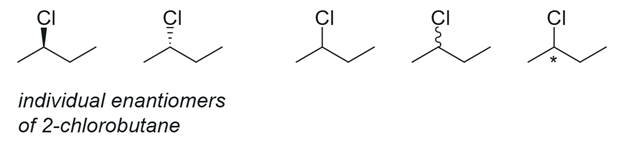
Show a group of organic chemists the structures of 2-chlorobutane below (Figure 1), and they might all have different interpretations of each. Depending on the reader, those might be taken as conveying an individual stereoisomer, a mixture of stereoisomers, a single stereoisomer where the absolute configuration is unknown, a sample with nothing known about stereochemistry, or something else entirely. Authors and figure creators often rely on additional context, such as an accompanying reaction or company conventions, to convey the full stereochemical meaning of their drawings.

Graphical depictions of 2-chlorobutane.

Figure 1. Graphical depictions of 2-chlorobutane. Depending on the author and reader, the meaning may be or may not be interpreted as intended.
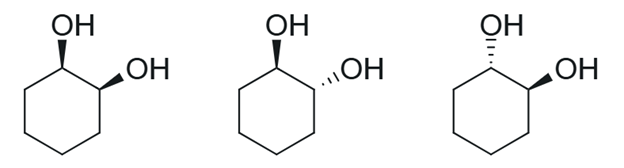
Compounds with multiple stereocenters offer additional challenges. Wedged and hashed bonds are used in these cases to indicate both absolute and relative stereochemistry. There are three stereoisomers of cyclohexane-1,2-diol (Figure 2). Wedged and hashed bonds are used to differentiate the cis- and trans-relative configurations. With two enantiomeric trans-compounds, a chemist would likely interpret a single trans-structure as that specific enantiomer and not a mixture. However, in some cases, the author might imply the mixture based on context (e.g., racemic products of a reaction).

Stereoisomers of cyclohexane-1,2-diol.
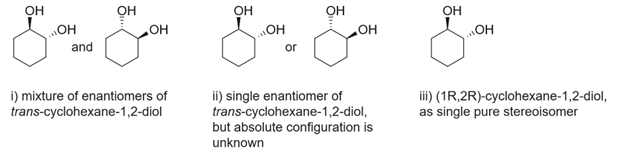
Figure 2. Stereoisomers of cyclohexane-1,2-diol.

Best practices for drawing stereochemistry

IUPAC’s guidance can be found in its recommendations from 2006 “Graphical Representation of Stereochemical Configuration.”1 Their suggestions are meant to address situations including known absolute stereochemistry, unknown absolute stereochemistry of a single stereoisomer, mixtures of enantiomers (racemic or otherwise), known relative stereochemistry but unknown absolute configuration, unknown relative stereochemistry, and unknown or unspecified cases.

  • Plain, flat, and wavy bonds should be used when configuration is unknown, with limited exceptions. For example, wavy bonds have been used historically for representing mixtures of anomers in carbohydrates, so that notation is broadly understood in that community.
  • Avoid the use of asterisks to indicate or highlight a stereocenter, since they have multiple meanings in the literature (e.g., specifying isotopically labeled positions and excited states).
  • Solid wedged and solid hashed bonds should be assumed to represent absolute configuration, unless accompanied by additional structures and/or explanatory text. Use “and” and “or” along with structural drawings to clearly indicate what is known about the compound described.
Unambiguous depictions of trans-cyclohexane-1,2-diol.
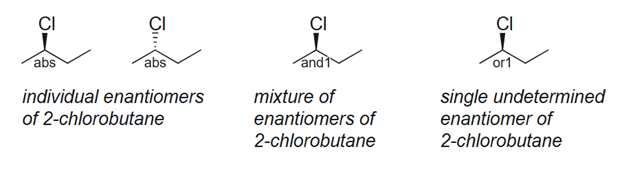
Figure 3. Unambiguous depictions of trans-cyclohexane-1,2-diol.

Best practices for registering and storing structural information in a database

Many representations of organic structures are now available to chemists and cheminformaticians.

MDL’s V3000 molfile format is conveniently aligned with IUPAC’s recommendations for authors. Like most formats, the V3000 molfile includes wedged and hashed bonds. Moreover, the V3000 molfile introduced atom-wise specification of ABS (absolute), AND, and OR labels to define what is known for stereocenters. These “enhanced stereolabels” provide a straightforward way to represent situations like those above as a single drawing. For compounds with a single stereocenter, this clearly differentiates single known enantiomers (ABS), racemic mixtures (AND), and single unknown enantiomers (OR) (Figure 4).

Enhanced stereochemical labels distinguish stereopure compounds, racemic mixtures, and unknown stereochemistry.
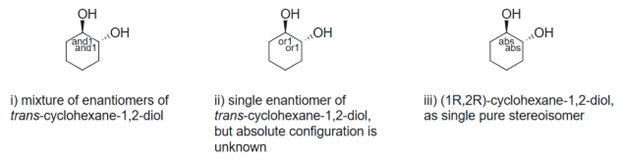
Figure 4. Enhanced stereochemical labels distinguish stereopure compounds, racemic mixtures, and unknown stereochemistry.

For compounds with multiple stereocenters, a common situation is that the relative stereochemistry is known, while absolute stereochemistry may not be. Enhanced stereolabels are appended with a digit to show dependency between two centers.

For example, in the series of trans-cyclohexane-1,2-diols, the AND1 designation at both stereocenters enforces that the relative stereochemistry is trans and both trans enantiomers are present. Similarly, the OR1 designation defines the relative stereochemistry as trans, but it is unknown which absolute configuration is present. As with compounds with single stereocenters, the ABS label indicates the stereochemistry is known as indicated by the wedged or hashed bond.

Enhanced stereochemical labels distinguish enantiomers, diasteromers, and stereopure compounds.

Figure 5. Enhanced stereochemical labels distinguish enantiomers, diasteromers, and stereopure compounds.
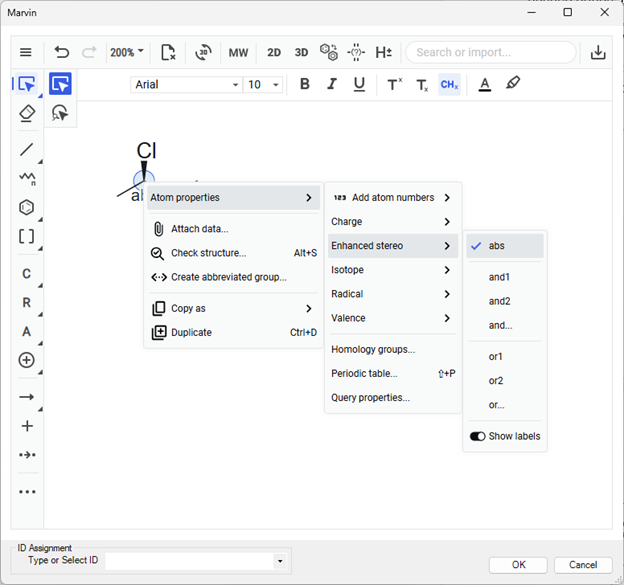
Our chemical editor Marvin allows users to set ABS, AND, and OR parameters to clearly define their stereochemical intention. Structures in Marvin may be output as V3000 molfiles, along with our own MRV (XML) and CXON (JSON) formats, all of which support the enhanced stereolabels. Marvin is being integrated into our other products, including Compound Registration, Design Hub, Compliance Checker, cHemTS, and D360.
Find out more about Marvin -»

Setting enhanced stereolabels in Marvin.
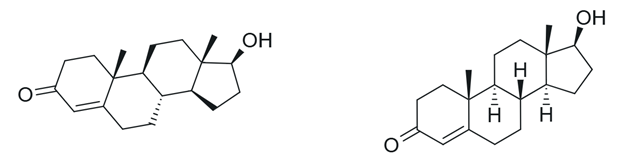
Figure 6. Setting enhanced stereolabels in Marvin.

Increasing complexity brings additional challenges to drawing stereochemistry

As compounds increase in size and complexity, chemists may be forced to construct drawings that don’t match the simplest conventions, so that drawings are both clear and chemically accurate. One of the first rules that chemists learn about drawing compounds with bond-line notation is that hydrogen atoms are implied at carbons. Yet there are times that explicitly denoting hydrogen atoms is helpful for clarity.

For example, dropping the SMILES string for testosterone into a modern chemical editor such as Marvin will likely produce a drawing like that at the left of Figure 7. However, we are much more likely to see a representation like that on the right in the literature. Explicitly drawing the hydrogens at the ring junctions emphasizes the trans-fusion of the rings to the reader. This traditional drawing follows IUPAC’s guidance that “Stereogenic centers at ring fusion atoms should be drawn with hashed wedged or solid wedged bonds to the exocyclic substituent at the fusion atom whenever possible.” Chemical drawing programs may not follow that guidance by default.

Depictions of testosterone

Figure 7. Depictions of testosterone.
When speaking to chemists, our team often hears about the challenges of drawing macrocycles.

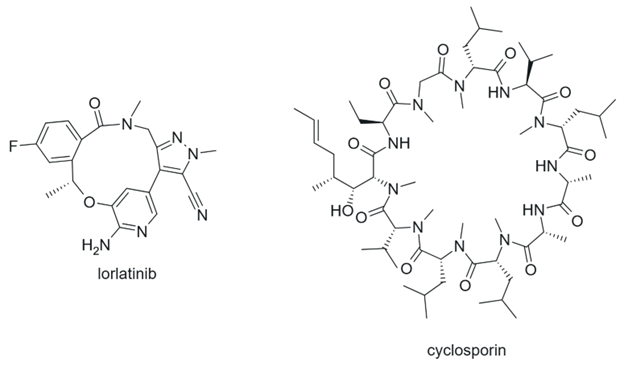
Most macrocycles of interest are decorated with pendant groups, each defining a stereocenter, and the requirement to be cyclic places groups in proximity. The author is often forced to make aesthetic choices that don’t conform to their standard practices for acyclic compounds or smaller ring sizes. Rings with 9 or more members may be drawn as fully convex polygons or non-convex polygons. The former allows drawings to be treated “more linear like” and may make it easier to unambiguously and accurately depict stereochemistry, such as lorlatinib in Figure 8.

However, bond angles in these drawings are skewed and unlikely to be close to any realistic conformation. Non-convex polygons allow bond angles to approach the idealized 120° that chemists expect to see (whether or not they resemble actual conformations), but care must be taken to draw stereochemistry accurately. IUPAC’s recommendation is to find a depiction that keeps pendant groups on atoms pointing toward the “outside” of the polygon, such as in cyclosporin at the right of Figure 8.

Macrocycles

Figure 8. Macrocycles.

IUPAC acknowledges that some drawings have been present in the literature for so long that they are acceptable, even if they don’t follow their guidelines.

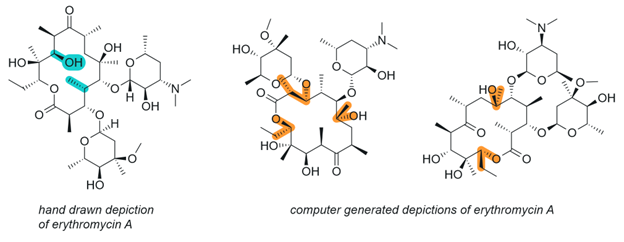
For example, erythromycin A is traditionally depicted as shown at the left in Figure 9. This drawing has features that do not conform to IUPAC’s recommendations. The two stereocenters highlighted in blue are at “re-entrant” carbons, that is, carbons where the ring bonds point toward the center of the ring. Chemical drawing programs may place groups with the correct stereochemical configuration, but with bond angles that make it difficult for a chemist to confirm. At the right of Figure 9 are two autogenerated drawings of erythromycin A. Highlighted in orange are stereocenters that a chemist would likely manually edit, and they should take care to ensure that the configuration remains correct after those adjustments.

At least for now, macrocycles and compounds of similar complexity should be treated with care by chemists.

Hand drawn and computer generated depictions of erythromycin A.

Figure 9. Hand drawn and computer generated depictions of erythromycin A.

Conclusion

Similar to the spoken word, the language of chemistry requires care to achieve clear and accurate structural drawings. In the current era, chemists are fortunate to have excellent software tools such as Marvin to assist in chemical drawing. Despite common conventions, additional guidance from IUPAC, and computational tools, ambiguity can still arise when communicating, capturing, and storing chemical data. What distinguishes a skilled chemist is their ability to convey complex structures, including stereochemistry and related features, to the

To clearly and accurately draw stereochemistry, check out Marvin -»

References

1. Graphical Representation of Stereochemical Configuration (IUPAC Recommendations 2006), https://iupac.qmul.ac.uk/drawing/stereo.html

Author

Jeremiah Malerich, PhD

Solution Consultant

Dr. Jeremiah Malerich is a Solution Consultant working in the Discovery Portfolio of Certara. He joined Chemaxon – acquired by Certara in 2025 – two years ago after a long career in the CRO business supporting drug discovery programs. In his previous life, he saw how critical robust cheminformatic tools were to the success of programs, and he now brings that experience to Certara and its partners. His background is synthetic organic chemistry with a PhD from the University of California, Berkeley.

Book a Demo

Reach out to us

– Leave your contact information
– Summarize what you are looking for
– Our colleagues will get back to you soon