



search

March 17, 2026

In 2018, the FDA’s Oncology Center of Excellence created an Assessment Aid pilot program that sponsors can participate in to facilitate reviews of oncology NDA/BLA reviews (including supplements).

The Assessment Aid is a stand-alone document based on the Multidisciplinary Review template and includes the application’s key points. According to FDA, the goal of an Assessment Aid is “to focus the FDA’s written review on critical thinking regarding the adequacy of the data and strength of results, reducing the time spent on recapitulation of information and administrative tasks such as formatting”.

Over the past 8 years, the Assessment Aid has remained voluntary, and no other FDA divisions have implemented its use. For applications being submitted as part of the Real-Time Oncology Review (RTOR) program, the FDA prefers that an Assessment Aid be provided, but it’s not mandatory.

However, we believe that participating in this program is beneficial even though it’s not required.

How many FDA approvals have participated in the Assessment Aid program?

As shown in the table below, there were 5 sponsors who participated (and received approval) in the pilot program in 2018, the first year of implementation. The total number of FDA oncology approvals that included an Assessment Aid increased 4-fold in 2019 and then doubled in 2020. Since 2020, approximately 40 applications/year have been approved that included an Assessment Aid.
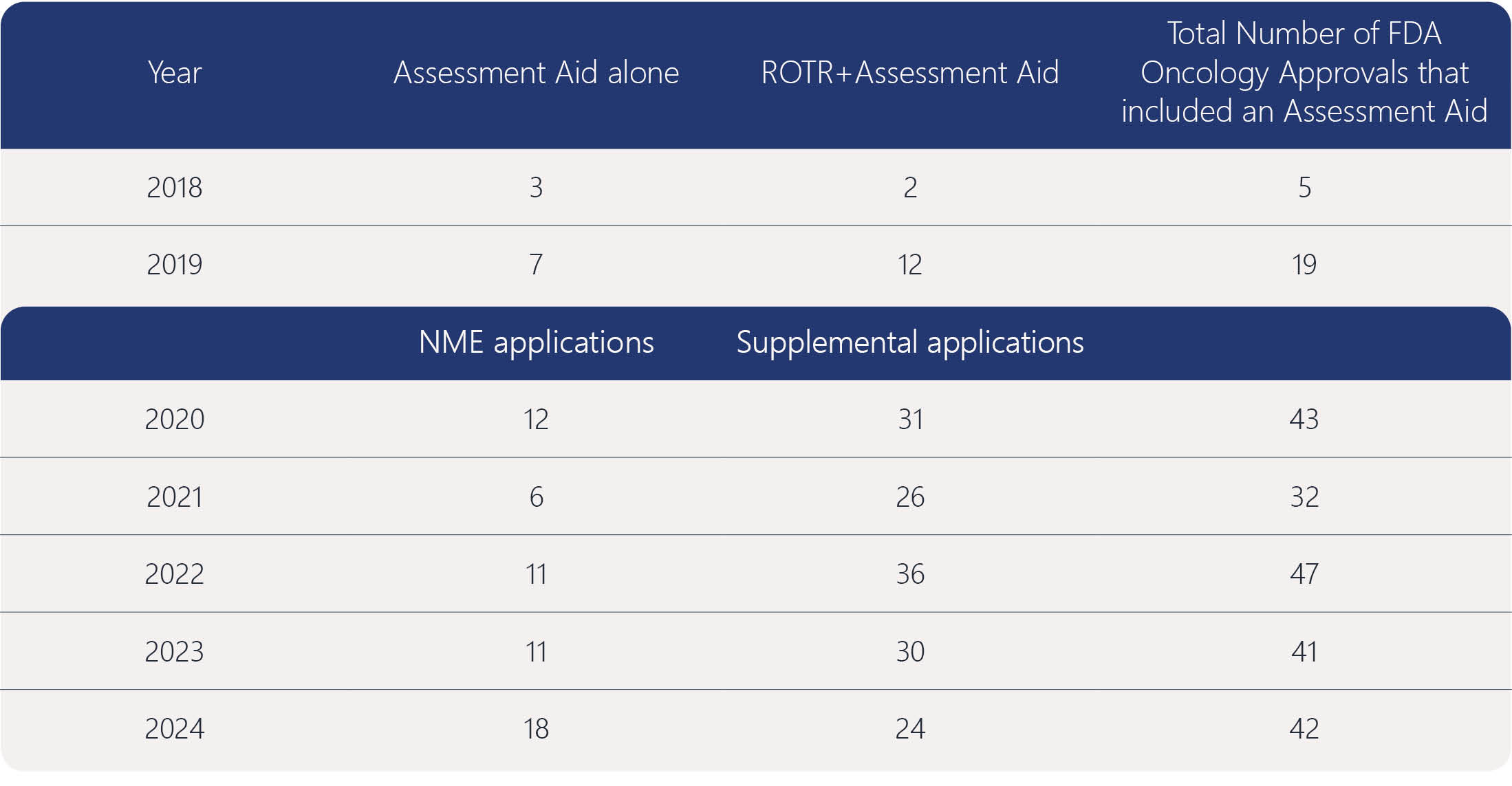
Table showing yearly FDA oncology approvals with assessment aids from 2018 to 2024, including counts for NME and supplemental applications.

Note: This table only includes applications for which the drug was approved; it does not account for applications that were filed and have not received approval.

What content is provided in an Assessment Aid?

The Assessment Aid is a general template that includes sections for nonclinical data and clinical pharmacology, efficacy, and safety data. If there is no new information to provide, (e.g., a supplemental application with no new nonclinical or clinical pharmacology data), then those sections can state “No new information is provided in the current submission.”

Most sections of the template include the following subsections:

  • a data portion to be completed by the applicant (e.g., tables and figures)
  • the applicant’s position, which is to be completed by the sponsor and provides their interpretation of the data
  • the FDA’s assessment, which is to be completed by FDA and includes their analysis of the data and applicant’s position

What are the guidelines?

An Assessment Aid should be written concisely and only include critical information as there are page limitations (i.e., total document should be no longer than 100 pages for initial applications or 75 pages for supplemental applications). FDA also clearly states that “promotional language should be avoided.”

The information provided in an Assessment Aid should be self-sufficient; it should not refer to sections of the application for further information, and all applicable key tables and figures should be placed directly in the document template. In addition, there should be no new data that is only presented in the Assessment Aid; all content should come from existing sources (clinical study reports, CTD summary modules, integrated summaries) in the application.

What are our recommended best practices for writing an Assessment Aid?

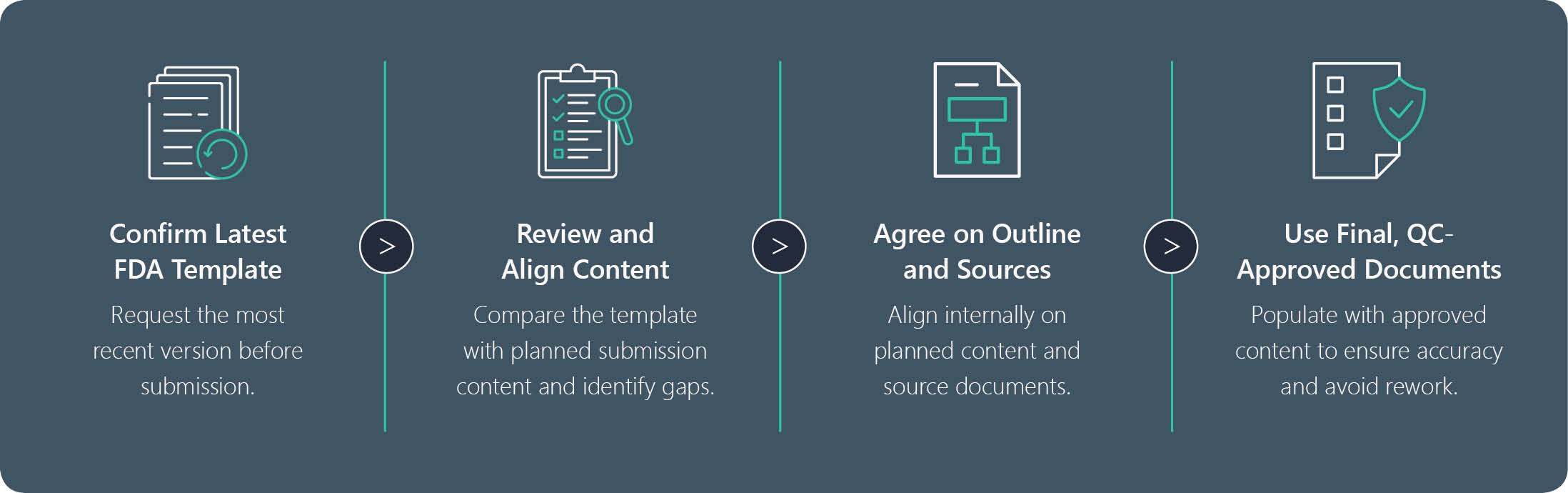
Certara regulatory writing collaborates with multiple sponsors each year to provide Assessment Aids as part of their FDA oncology applications. Our recommended best practices for preparing an Assessment Aid are as follows:

  • Request the most recent version of the template close to the time of submission (e.g., at the pre-NDA/BLA meeting) as it is a dynamic template that you want to ensure you have the most recent version of.
  • Review the template sections and evaluate what content is to be provided versus your planned submission content. This review may reveal an inadvertent deficiency in the application that can be addressed before the application is submitted.
  • Prepare and gain early internal agreement of an outline that identifies the planned content and source documents (e.g., tables and figures from clinical study reports, CTD summary modules, integrated summaries).
  • Use final (content approved), QCed source documents to populate to ensure consistency and accuracy. This will avoid rework and also streamline the review process as there is little/no unapproved content that reviewers have not seen. Also, since the document is submitted in a Microsoft Word format (i.e., not published) so FDA can add their analysis into the document, it can be one of the last documents written and finalized and placed in the submission package (i.e., just days before the submission).
Four-step workflow showing best practices for FDA submissions: confirm template, review content, align sources, and use QC-approved documents.

Strengthen your oncology submission strategy

The FDA Assessment Aid can streamline oncology NDA and BLA reviews, improve regulatory clarity, and support Real-Time Oncology Review and Priority Review pathways. However, successful implementation requires strategic planning, disciplined execution, and experienced regulatory writing expertise.

Certara’s global regulatory writing and submissions team supports sponsors across the full lifecycle of oncology applications, including Assessment Aids, NDA and BLA submissions, eCTD publishing, and regulatory operations.

If you are preparing an oncology submission and considering participation in the Assessment Aid program, our experts can help you plan, draft, and integrate this document seamlessly into your regulatory strategy.

Author

Karen Randolph

Karen Randolph has 20 years of experience in the pharmaceutical industry. She leads multifunctional teams in developing strategies and documentation for orphan drug designation applications and marketing applications for approval of orphan drugs in the United States and other geographies such as the European Union.

References

FDA Oncology Center of Excellence. 2018 Annual Report. https://cdn.cancerhistoryproject.com/media/2023/03/03144018/oncology-center-excellence-2018-annual-report-04.10.19_3.pdf. Accessed 18 December 2025.

FDA Oncology Center of Excellence. 2019 Annual Report. https://cdn.cancerhistoryproject.com/media/2023/03/06145827/OCE-2019-Annual-Report_508_V3.pdf. Accessed 18 December 2025.

FDA Oncology Center of Excellence. 2020 Annual Report. https://cdn.cancerhistoryproject.com/media/2023/03/06145827/OCE-2019-Annual-Report_508_V3.pdf. Accessed 18 December 2025.

FDA Oncology Center of Excellence. Oncology Regulatory Review (2021 Annual Report). https://www.fda.gov/about-fda/2021-oce-annual-report/oncology-regulatory-review. Accessed 18 December 2025.

FDA Oncology Center of Excellence. Oncology Regulatory Review (2022 Annual Report). https://www.fda.gov/about-fda/2022-oce-annual-report/oncology-regulatory-review. Accessed 18 December 2025.

FDA Oncology Center of Excellence. Oncology Regulatory Review 2023. https://www.fda.gov/about-fda/2023-oce-annual-report/oncology-regulatory-review-2023. Accessed 18 December 2025.

FDA Oncology Center of Excellence. Oncology Regulatory Review 2024. https://www.fda.gov/about-fda/2024-oce-annual-report/oncology-regulatory-review-2024. Accessed 18 December 2025.

FDA Oncology Center of Excellence. Assessment Aid. https://www.fda.gov/about-fda/oncology-center-excellence/assessment-aid. Accessed 18 December 2025.

FDA Oncology Center of Excellence. Real Time Oncology Review Pilot Program. https://www.fda.gov/about-fda/oncology-center-excellence/real-time-oncology-review. Accessed 18 December 2025.

This blog was originally published in July 2021 and has been updated for accuracy.

FAQs

Is the FDA Assessment Aid required for oncology NDA or BLA submissions?

No, the FDA Oncology Assessment Aid is voluntary and not required for NDA or BLA submissions. However, the FDA prefers its inclusion for applications submitted under the Real-Time Oncology Review (RTOR) program. Participation has increased significantly since 2018, reflecting its value in facilitating oncology application reviews.

What information is included in an FDA Oncology Assessment Aid?

The Assessment Aid uses a standardized template covering nonclinical data, clinical pharmacology, efficacy, and safety. For supplemental applications without new data, sponsors may indicate that no additional information is included. The document summarizes key evidence from the submission and should not introduce new data.

Does using an Assessment Aid improve FDA review timelines?

The Assessment Aid is designed to streamline FDA review by focusing on critical data and analysis rather than recapitulating information. While it does not guarantee faster approval, it can support review efficiency, particularly in oncology submissions and RTOR pathways.

Let’s transform your regulatory journey