



search

February 10, 2026

Inflammatory bowel disease (IBD), including ulcerative colitis (UC) and Crohn’s disease (CD), is immunologically complex, clinically heterogeneous, and notoriously difficult to optimize in development as evidenced by efficacy ceiling observed across clinical studies for multiple biologics. IBD drug development has faced such challenges but this gap is exactly where Quantitative Systems Pharmacology (QSP) proves valuable. QSP combines mechanistic biology with pharmacology and clinical data to simulate how therapies modulate immune pathways and clinical scores over time, enabling not just predictions of average patient behavior, but a distribution of virtual patients that reflect observed variability.

At Certara, we’ve advanced this approach in IBD drug development by building a platform QSP model designed to predict clinical disease activity scores, and by integrating machine learning with mechanistic immunology to connect simulated gut inflammatory biology to trial endpoints.

Why IBD drug development needs better prediction of clinical endpoints

IBD trials frequently rely on composite or categorical clinical endpoints that include physician assessment (e.g., endoscopy) and patient-reported outcomes. Meanwhile, common biomarkers (such as fecal calprotecin or serum C-reactive protein) can be informative, but don’t always track cleanly with disease severity or mucosal healing.

This creates practical challenges for R&D teams:

  • Biology is measurable; endpoints are multi-factorial. Gut cytokines, immune cell activity, and barrier processes can be modeled mechanistically, but clinical scores also include components that are subjective or not directly observed in typical datasets.
  • Heterogeneity drives mixed responses. Two patients can share similar baseline measures such as disease severity and still diverge in drug exposure, and treatment response.
  • Combination treatment strategies are promising, but hard to prioritize. The search space for combinations, sequences, and dosing cannot be assessed by clinical studies alone.

Certara’s approach targets those pain points by using a mechanistic IBD QSP model as a foundation, then extending to clinical score prediction through machine-learning mapping to severity categories.

What is a QSP model, and why it matters for MIDD

QSP sits within the broader discipline of Model-Informed Drug Development (MIDD): using quantitative models of disease biology and drug pharmacology to improve decision-making across drug discovery and development. QSP is especially valuable when you need an explainable, causal framework, one that can connect:

drug → target engagement → pathway modulation → tissue inflammation → biomarkers → clinical outcomes

Because QSP models are mechanistic, they do more than fit curves: they can generate testable hypotheses about why subpopulations respond, why responses wane, and which mechanisms may be synergistic. Therefore, optimizing trial design and novel drug strategies such as combination therapies.

That’s also why QSP leverage virtual patients, parameterized instances of the model that reflect plausible baseline disease state, drug PK and response, and observed variability, supporting in silico trials that can prioritize and optimize clinical studies.

Inside Certara’s IBD QSP Model (Crohn’s + ulcerative colitis in one platform)

Certara’s Inflammatory Bowel Disease (IBD) QSP Model is a mechanistic multi-state mathematical model built to simulate disease mechanisms and treatment outcomes, with the explicit goal of predicting clinical disease activity scores.

What the IBD model simulates: immune biology across key compartments

The platform captures key biological compartments and inflammatory dynamics relevant to IBD drug development, including:

  • Blood, gut, and lumen compartments
  • Key immune cell types and cytokines representing key drivers of gut inflammation
  • Key biomarkers and clinical scores

In other words, it’s built to represent the mechanistic “engine” underlying inflammation and treatment response, not just surface-level biomarkers.

What it predicts: from biomarkers to clinical score prediction

The IBD model is designed to provide insights into:

  • Gut tissue inflammation
  • Necroptosis
  • Clinically measurable biomarker estimation
  • Clinical score prediction

And importantly, it supports predictions for endpoints commonly used in IBD drug development, including Mayo score and CDAI.

Built for modern modalities and strategy questions

Because the model is positioned as a platform, it can be applied across multiple development questions and modalities, including:

  • Small molecules
  • Anti-cytokine antibodies (monoclonal and multi-specifics)
  • Combination therapies

That breadth matters because IBD pipelines rarely hinge on one asset, teams need a reusable framework that scales across a portfolio.

The breakthrough: linking mechanistic biology to clinical scores with machine learning

Historically, QSP has been strongest at predicting mechanistic species (cells, cytokines, biomarkers). Extending those simulations to clinical disease activity scores is harder for two key reasons:

  1. Lack of mechanistic understanding, such as the causal relationship between immune cell activity, gut inflammation, and clinical scores
  2. Limited paired datasets, such as individual-level patient gut biopsy measures tied directly to score components over induction and maintenance treatment periods with or without prior treatment history
  3. Subjective elements within composite scores that don’t map 1:1 to a mechanistic variable such as physician global assessment and patient-reported symptoms

Certara’s article, “Combining mechanistic modeling with machine learning as a strategy to predict inflammatory bowel disease clinical scores,” describes this strategy framing the core idea clearly: use mechanistic simulation for inflammatory markers, then apply a machine learning algorithm to predict IBD clinical scores.

The workflow: virtual populations → ML mapping → categorical endpoints

The score-prediction platform is described as:

  • Start with a mechanistic IBD QSP model
  • Generate training data using virtual populations
  • Perform feature selection guided by published relationships between gut inflammation markers and scores
  • Train a statistical learning model (e.g., multinomial logistic classification) to classify disease severity (mild, moderate, severe) for endpoints such as Total Mayo, MES, and CDAI
  • Evaluate performance using standard classification metrics (e.g., ROC, sensitivity/specificity)

This framework is consistent with Certara’s IBD model, which predicts clinical scores through machine-learning integration with gut markers.

Why this matters: mechanistic explainability + endpoint relevance

This hybrid approach creates a practical bridge:

  • QSP provides causal biology and treatment mechanism
  • ML provides a robust mapping to complex clinical endpoints

Together, they enable teams to ask not only “Will a drug move a biomarker?” but “Will it likely shift Mayo score or CDAI, and in which patient types?”

What you can do with the IBD QSP platform

Certara positions the IBD QSP model as a decision-enabling platform for core strategy questions like target selection, dosage optimization, and clinical trial design.

Understand Clinical Trials Using Virtual Patients Enabled by Quantitative Systems Pharmacology

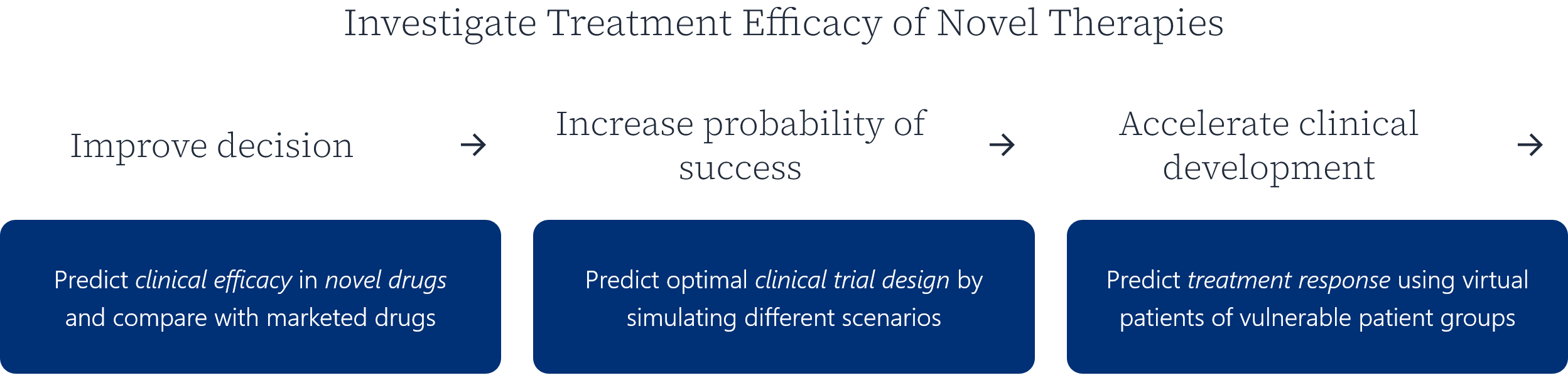
Investigate Treatment Efficacy of Novel Therapies

Improve decision

Increase probability of success

Accelerate clinical development

Predict clinical efficacy in novel drugs and compare with marketed drugs

Predict optimal clinical trial design by simulating different scenarios

Predict treatment response using virtual patients of vulnerable patient groups

QSP is a powerful tool to simulate in-silico clinical trials supporting decision-making during drug research & development.

Below are the highest-value use cases, aligned to what development teams actually need to decide.

1) Target selection: “Is this mechanism likely to work in UC and/or CD?”

The IBD model is framed around a common development challenge: IBD is not simply a plug-and-play extension of other autoimmune indications. Teams need a way to evaluate mechanisms in the specific IBD context and choose the right target and approach for the right patient.

With a mechanistic platform, you can simulate how new pathways interact with known inflammatory networks, and benchmark against therapies where clinical behavior is established.

2) Dose and regimen optimization: explore “what if” scenarios before the clinic

Because QSP explicitly incorporates PK variability and mechanistic response, it becomes a natural engine for:

  • Induction vs maintenance regimen tradeoffs
  • Exposure-response interpretation across heterogeneous patients
  • Sensitivity to binding properties and pharmacology assumptions

This is particularly useful when planning Phase 2 designs where endpoints are categorical, and variability is high.

3) Combination therapy strategy: prioritize synergistic mechanisms and responder biology

The platform supports combination therapies as a first-class use case. Combination scenarios are discussed as a way to push beyond current response ceilings and to understand why some patients respond while others retain elevated inflammatory signals post-treatment.

Mechanistically, this enables exploration of:

  • Which cytokines/cell programs remain “high” in non-responders
  • Which combinations plausibly address those residual drivers
  • Which patient endotypes are most likely to benefit

4) De-risking decisions when trials fail: use the model to test alternative explanations

One of the most valuable (and underappreciated) QSP use cases is decision de-risking. When a therapy fails, teams often face competing hypotheses (target invalidation vs dosing vs patient selection vs mechanism nuance). A mechanistic model lets you test: Is a failure explainable via exposure and pharmacology alone? Would an alternative dose plausibly change the outcome?

This can directly impact portfolio decisions: whether to halt, redesign, or reposition a program.

Model quality and validation: “learn and confirm,” not “build once”

Platform models must earn trust. The validation mindset is described as an iterative learn-and-confirm paradigm:

  • Calibrate to existing data for a credible baseline
  • Validate on independent datasets the model has not “seen”
  • Run blind predictions (simulate before readout; compare after)
  • Apply sensitivity/uncertainty analyses to understand robustness

That approach matters for score prediction in particular, because mapping biology to categorical endpoints can introduce bias if not validated on independent outcomes.

Certara IQ™: the delivery engine for scalable IBD QSP

Certara’s IBD QSP model is part of a broader ecosystem that includes Certara IQ™, positioned as an AI-enabled QSP modeling platform, with libraries spanning pharmacologies and therapeutic areas.

Practically, that matters because the bottleneck for many teams isn’t the idea of QSP, it’s scaling:

  • Reuse across multiple assets
  • Consistent workflows across teams
  • Faster iteration when new data arrives
  • Portfolio-wide application rather than one-off modeling

Learn more about Certara IQ

Certara IQ is the AI-enabled QSP modeling tool that will transform your research and scale your molecule’s potential.

Certara IQ offers flexible and scalable licensing options to cater to a variety of users and organization sizes.


Learn moreSee Certara IQ in action

Author

Douglas Chung

Douglas W. Chung, BS, MS

Sr Director, QSP

Douglas W. Chung is a highly experienced scientist and consultant specializing in mechanistic modeling to support drug discovery and development. His background is in biomedical engineering and his focus is in quantitative systems pharmacology with over 12 years of experience consulting in biotech and pharmaceuticals. His passion is to grow the field of quantitative pharmacology by expanding diversity in people, fields of expertise, and clinical trial populations.

FAQs

Why is predicting clinical scores important in IBD drug development?

IBD trials are often powered and judged by categorical clinical endpoints, not biomarkers alone. Predicting scores like Mayo and CDAI helps teams:

  • assess likely clinical efficacy earlier
  • optimize dose and regimen
  • prioritize targets and combinations
  • reduce late-stage trial risk

How are QSP models validated for clinical decision-making?

QSP models are validated using a learn-and-confirm approach, which typically includes:

  • calibration to existing clinical data
  • validation against independent datasets
  • blind predictions before trial readouts
  • sensitivity and uncertainty analyses

This builds confidence that the model can support real development decisions.

How does machine learning complement QSP in IBD drug development?

QSP provides mechanistic explainability, while machine learning enables robust mapping to complex clinical endpoints. Together, they allow teams to translate biological insight into clinically meaningful predictions, without losing interpretability.

See Certara IQ in Action