



December 12, 2025
Discover how to build standardized electronic case report forms (eCRFs) across multiple EDC systems to improve data quality, accelerate study builds, and ensure regulatory traceability, based on insights and poll results from our recent webinar The Impact of Standardized eCRFs from Data Collection to Submission.
How to build standardized eCRFs across multiple EDC systems
Our recent webinar brought together data managers, clinical programmers, and clinical trial leaders to explore a common challenge in modern clinical research: building standardized eCRFs that work seamlessly across multiple EDC systems.
Led by Jen Manzi (Associate Director & Solutions Consultant) and Martin Johnston (Consultative Services Manager), the session explored the “case of the people versus non-standardized CRFs,” making a compelling argument for why standardization is more than just a best practice – it can give you a strategic advantage.
The case for standardization
In the “court of data standards,” our experts laid out the key charges against non-standardized CRFs: inefficiency, inconsistency, and downstream complications. They showed how disorganized form design introduces major risks throughout the data lifecycle from EDC build to submission.
Key pain points without standardization:
- Forms don’t align with EDC specifications, causing setup errors and delays
- Version control issues create confusion and rework
- Inconsistent metadata prevents reuse and automation
- Regulatory compliance becomes harder to prove
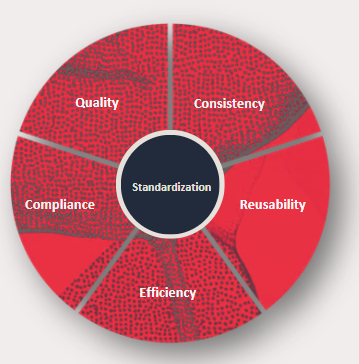
On the other hand, standardization transforms CRFs from a bottleneck into a foundation for speed and quality. It ensures that the same data is collected in the same way across studies. It also improves traceability, and reduces review cycles.
Evidence for the benefits
Jen and Martin explained the downstream impacts of standardization, illustrating how benefits compound across the clinical data pipeline:
1. Faster EDC builds
Reusable form libraries speed up study set up. Using consistent naming conventions makes study build faster and reduces manual errors.
2. Improved data entry and quality
Sites benefit from familiar layouts and controlled terminology, cutting down data-entry errors and queries.
3. Streamlined SDTM mapping
Standardized CRFs allow pre-mapped SDTM domains and automation, reducing the need for manual programming and additional validation cycles.
4. Traceable ADaM creation
Consistent metadata enables reuse of macros and ensures traceability from CRF to analysis datasets (ADaM), ensuring your submission package is regulatorily compliant.
5. Smoother submission preparation
Standardized CRFs lead to cleaner SDTM datasets, faster generation of define.xml and reviewer guides, and fewer questions from regulatory reviewers.
Poll results: what the industry thinks
During the webinar, we asked the audience about their standardization journeys:
The majority of attendees reported their organizations use multiple EDC systems:
- Medidata Rave: 63%
- Oracle Clinical One or InForm: 15%
- Veeva Vault EDC: 37%
- Others (e.g. OpenClinica, Castor, Medrio, BioClinica/Clario): 46%
- REDCap: 7%
A majority cited increased costs, inconsistencies and delays as the most significant problems caused by non-standardized eCRFs:
- Increased costs (e.g. through repeated work): 72%
- Inconsistencies: 81%
- Compliance risk: 64%
- Delays in time to analysis: 72%
- Delays in submission: 67%
When asked what benefits they believe their organizations could realize by standardizing eCRFs, the audience answered:
- Increased traceability: 81%
- Reduced risk: 81%
- Smoother preparation of submission deliverables: 85%
- Increased reuse: 88%
- Improved compliance with regulatory standards: 87%
These results show that while the industry recognizes the need for standardization, many are still in the early stages of implementation, particularly when juggling multiple EDC environments.
Real-world example: Biogen’s transformation
Biogen, a leading biotechnology company headquartered in Cambridge, MA, faced challenges when managing study metadata across a growing global portfolio.
Before standardization:
- CRFs were managed in Excel with decentralized processes
- Version control was manual and error-prone
- Teams struggled to reuse content efficiently
After adopting Pinnacle 21 Enterprise:
- Biogen centralized all clinical trial metadata within a Metadata Repository (MDR)
- Established controlled terminology and CDASH-aligned metadata standards
- Enabled cross-study reuse, strong audit trails, and visual version tracking
- Improved compliance and streamlined updates from ADaM 1.1 to 1.3
Biogen’s transformation demonstrates how implementing standardized eCRFs within a centralized MDR can deliver efficiencies and long-term scalability. Read the full Biogen case study.
Building standardized eCRFs across multiple EDC systems
So, how can organizations start standardizing effectively when working with multiple EDC vendors?
Our experts recommend:
- Centralize your standards. Use an MDR, such as Pinnacle 21 Enterprise, to create a single source of truth for CRF metadata.
- Define global and therapeutic area standards. Build reusable libraries that can be extended to study-specific forms.
- Integrate with your EDCs. Certara’s CRF Creator software allows direct generation of EDC builds from standardized forms, with no manual re-entry required.
- Automate quality control. Standardized structures enable automated validation and faster review cycles.
- Maintain traceability. From CRF through SDTM and ADaM to submission, ensure every data element is linked and auditable.
With these practices, teams can achieve consistent form design across EDC systems like Medidata Rave, Veeva, and Oracle, improving study speed and submission confidence.
The verdict: metadata standardization is a strategic advantage
By adopting standardized eCRFs across multiple EDC systems, clinical teams gain:
- Reusable content and faster builds
- Higher data quality and compliance
- Reduced manual rework and mapping errors
- Stronger traceability from collection to submission
Our Pinnacle 21 Enterprise platform enables all of this within one connected environment, empowering teams to standardize and stay compliant.

Watch the webinar on demand
Missed the live session? You can view The Impact of Standardized eCRFs: From Data Collection to Submission and see a demo of Pinnacle 21 Enterprise CRF Creator in action.

Subject Matter Expert and User Advocate, Pinnacle 21 by Certara
Jen Manzi is a Subject Matter Expert and User Advocate at Pinnacle 21. She has over 20 years of Pharma/Life Sciences industry experience in Clinical Trials and Safety Data Management. Jen has held various roles within these areas, including eCRF Programmer, SDTM Delivery Lead, Product Owner and Programmer of Batch Processes, Vendor Relationship Manager, Program and Process Improvement Manager, and Validation Lead.
Further reading:
Blog post: What Should a Clinical Metadata Repository Do?
On-demand webinar: Faster Mapping from Source Data to Target SDTM
Blog post: Why are Clinical Data Standards Essential for EDC and Non-EDC Data?