


search

April 1, 2026

If drug development sometimes feels like searching for the right fact in a thousand places, that’s not your imagination. The evidence you need is often scattered across clinical systems, lab platforms, shared drives, PDFs, slide decks, study reports, and the scientific literature. In other words, up to 80% of your organizational data may be “dark,” meaning it’s present, but it’s hard to use. One big reason why? That data is sitting in unstructured formats like text documents.

That’s exactly the kind of mess a data fabric in pharma is meant to tame.

So, what is a data fabric?

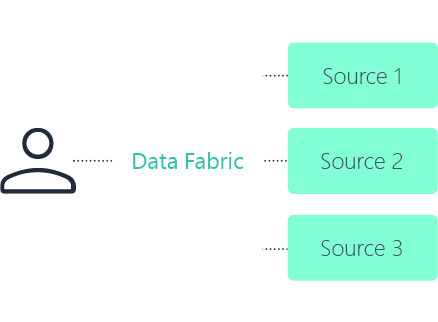
A data fabric is a design approach for connecting data across many systems (on-prem and cloud, structured and unstructured). Data fabrics provide a unified way to discover, access, govern, and deliver that data using metadata and automation.

A helpful way to think about it:

  • The data stays where it is (often for good reasons: validation, governance, ownership, performance).
  • The fabric provides an “integration layer” that makes the data findable and usable across workflows.
  • Access and policy are handled consistently through metadata and controls.

What is a clinical data fabric?

The difference isn’t in architecture, but in the content of the connected silos. A clinical data fabric (CDF) might unify everything from trial protocols to EHR data. More broadly, a “biopharma”, “drug development” or “life science” data fabric might include:

  • A chemical compound registry
  • Results from in vitro assays
  • Results from non-clinical studies
  • CMC records
  • Human trial documents and findings
  • Regulatory submissions
  • Global value dossiers
  • A link to web sources such as PubMed

That’s only a partial list. There is no official set of sources that make a data fabric a “clinical” or “discovery” data fabric. Still, whenever these sources contain proprietary data, it’s even more critical that the rules governing their security and management remain intact. Data fabrics respect those controls.

The value of a CDF lies in enabling secure, cross-study discovery without disrupting validated systems. Teams can retrieve evidence across trials, programs, and documents while maintaining access controls and traceability.

For many organizations, the CDF becomes the first high-impact step toward a broader data fabric in pharma.

Benefits of data fabrics in life sciences

A well-designed data fabric in pharma does more than connect systems. It enables faster, more reliable decision-making across the development lifecycle.

Key benefits of data fabric in life sciences include:

  • Faster cross-system search without duplicating validated data
  • Better use of unstructured content, including study reports and regulatory documents
  • Stronger governance, preserving source-system permissions and audit trails
  • Reduced duplication, avoiding unnecessary data movement
  • Improved AI readiness, supported by structured metadata and permissions-aware retrieval

In regulated environments, these capabilities translate into shorter cycle times, improved evidence reuse, and more traceable outputs.

What is “indexing” and what does it have to do with data fabrics?

In a data-fabric setup, indexing means creating a searchable representation of connected content so it can be discovered and retrieved through a single point of entry, without needing to copy everything into a new system.

Modern indexing often includes:

  • Metadata indexing: titles, authors, dates, study IDs, compounds, endpoints, source systems, and access controls
  • Content indexing: extracting text (and sometimes tables/structure) from documents like PDFs and Word files
  • Semantic indexing: representing meaning (often with embeddings) so “conceptual” matches work, not just keyword matches
  • Entity/relationship indexing: tagging key biomedical entities (drug, target, AE, population, endpoint) and how they relate, useful for exploration and graph-style queries.

What’s the difference between a data lake, a data mesh, and a data fabric?

Data lake

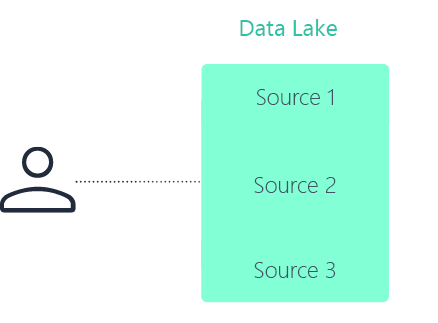
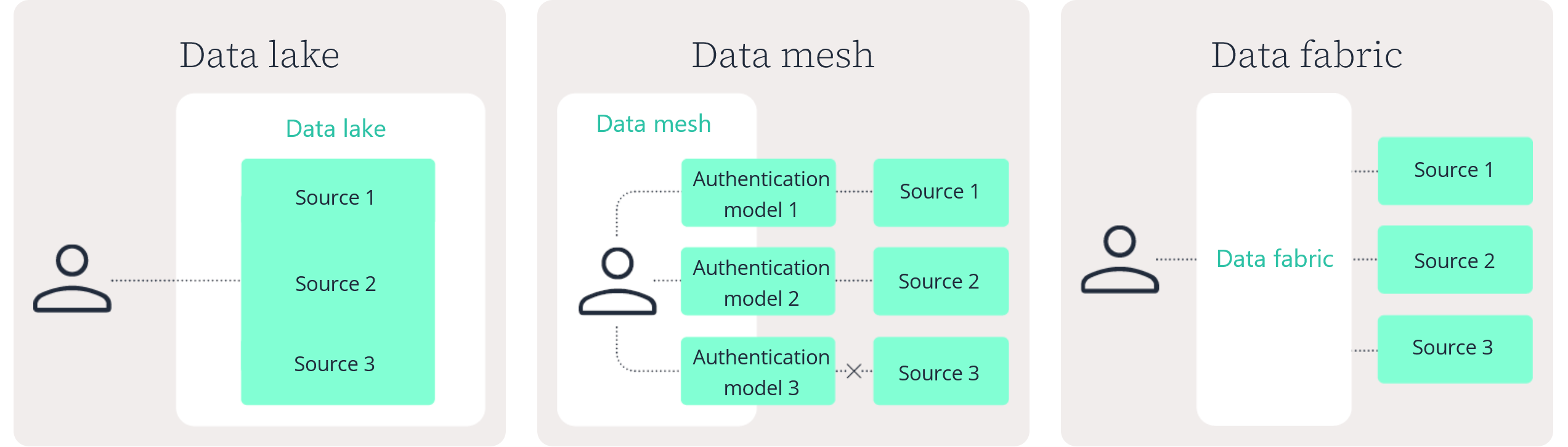
A data lake is a centralized repository that stores large volumes of raw data, structured and unstructured. Data is typically copied or ingested into the lake. While lakes can support analytics at scale, they may introduce duplication, governance challenges, and version-control complexity if not carefully managed.

Data mesh

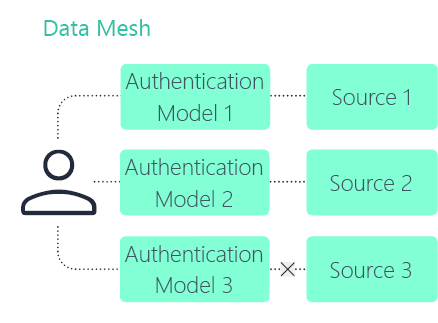
A data mesh is an organizational and governance model, rather than a specific technology. It promotes domain ownership of data, treating data as a product and distributing responsibility across teams. A mesh focuses on the operating model and accountability more than on integration architecture.

Data fabric

A data fabric is an architectural approach that connects data across systems without requiring everything to be moved into a single repository. It relies on metadata, indexing, and governance controls to enable unified discovery, access, and policy enforcement across distributed environments.

In practice:

  • A data lake centralizes storage
  • A data mesh decentralizes ownership
  • A data fabric connects and unifies access

These approaches are not mutually exclusive. A data fabric in pharma can connect existing lakes and operate within a mesh-style governance model, helping organizations improve discovery and compliance without rebuilding their entire data estate.

Data lake

Data lake
Source 1
Source 2
Source 3

Data mesh

Data mesh
Authentication model 1
Source 1
Authentication model 2
Source 2
Authentication model 3
Source 3

Data fabric

Data fabric
Source 1
Source 2
Source 3

Differences between data fabric and federated computing

Data fabric and federated computing are sometimes mentioned together because both aim to reduce unnecessary data movement. However, they solve different problems.

Federated computing (often discussed as federated learning in life sciences) is a computational approach. Instead of moving data into a central environment, algorithms are sent to where the data resides. The model trains locally, and only model parameters or aggregated results are shared centrally. This approach is commonly used when privacy, data residency, or institutional boundaries prevent raw data from being shared.

Federated computing is primarily about:

  • Distributed analytics or model training
  • Preserving privacy across institutions
  • Minimizing cross-border or cross-organization data transfer

A data fabric, by contrast, is an architectural approach for unified discovery, access, and governance across distributed systems. It focuses on metadata, indexing, and permissions-aware retrieval so users can find and use data across silos without centralizing everything.

A data fabric is primarily about:

  • Cross-system search and discovery
  • Consistent access control and policy enforcement
  • Connecting structured and unstructured content
  • Supporting traceable analytics and AI workflows

In practice:

  • Federated computing distributes computation
  • A data fabric unifies access and visibility

The two approaches are not mutually exclusive. A life sciences organization might use a data fabric to index and discover data across trials, institutions, and repositories, while using federated computing to train models on sensitive patient-level data that cannot leave its source environment.

In short, federated computing protects how models learn from distributed data. A data fabric improves how people and systems discover, access, and govern that data across the enterprise.

What is the role of Generative AI (Gen AI) in data fabrics?

How generative AI helps with unstructured drug-development intelligence

A data fabric provides governed, discoverable, high-quality, well-described data and metadata, which is exactly what generative AI needs to retrieve the right context, stay compliant, and produce reliable outputs.

Generative AI can help in three practical ways:

1) Retrieve evidence first, then summarize (grounded answers)

A common best practice is retrieval-augmented generation (RAG): retrieve relevant passages from an external index, then generate an answer grounded in those passages. This typically uses a dense/semantic index as an external “memory” for the model.

2) Extract structured data from unstructured sources

GenAI can pull structured fields (e.g., PK parameters, dosing, populations, endpoints, adverse events) out of narrative documents and turn them into analysis-ready tables, especially when extraction follows a defined schema and preserves relationships among fields.

3) Improve trust with references and traceability

In regulated settings, speed only helps if results can be verified. A strong pattern is “answers with receipts”: show the supporting source passages and maintain traceability from source → extraction/summarization → output.

Best practices for using data fabrics in drug development

Design around decisions and workflows

Start with a small number of high-value workflows (e.g., trial feasibility, safety signal review, evidence synthesis) and connect only what’s needed first.

Prefer “connect and unify” over “move and rebuild”

When possible, connect systems in place and avoid duplicating data into yet another lake or warehouse, especially where validation and data ownership matter.

Treat metadata as the backbone

Use active metadata to drive search, governance, lineage, and automation. Permissions-aware retrieval should be part of the design, not an afterthought.

Make indexing continuous and governed

Indexes become unreliable when they drift. For high-change sources, near-real-time indexing helps keep answers current.

Build “reference-first” GenAI workflows

Use RAG-style grounding, require citations, and design review checkpoints. This reduces hallucination risk and helps with QC and validation.

Align with modern quality and risk-based expectations

Clinical and development environments increasingly emphasize risk-based quality approaches and responsible use of modern technologies, which makes auditability and controlled workflows especially important.

Make data more reusable over time

Applying FAIR-style thinking (Findable, Accessible, Interoperable, Reusable) helps the fabric support not just one project, but cross-program learning and reuse.

Use cases across the lifecycle

These are common, high-impact patterns where data fabrics and reference-backed GenAI tend to pay off.

1) Clinical trial feasibility, eligibility screening, and enrollment support

Trial enrollment often stalls because critical signals are spread across structured records and unstructured notes/criteria text, making matching slow and inconsistent.

A data fabric in pharma can connect patient records, genomics data, and trial information (without replicating everything), enabling faster search, relationship discovery, and more transparent matching rationale.

2) Translational and pediatric research across multimodal data

Some programs need to connect genomics formats (e.g., VCF/BAM), literature, images, and clinical context. A fabric supports cross-source search and harmonization, while AI-based extraction and entity recognition can enrich what’s retrievable, even beyond existing ontologies.

3) Cross-program “asset intelligence” for discovery and preclinical work

Teams frequently need rapid answers like: What’s been tested before? What signals appeared? Where are the relevant reports? A fabric makes it possible to retrieve evidence across many repositories and summarize it with traceable references, without manually hunting through systems.

4) Evidence extraction and synthesis for analysis-ready datasets

Many workflows require turning narrative documents into structured datasets (e.g., endpoints, arms, doses, populations, outcomes). A fabric supplies the retrieval foundation; GenAI supplies the extraction layer, especially when prompts/workflows are schema-driven, and QC is built in.

5) Regulatory and quality documentation support

Regulatory work is fundamentally evidence assembly. A fabric enables fast retrieval across relevant sources, and grounded GenAI can accelerate drafting and review, so long as outputs remain reference-backed and reviewable.

How Certara.AI can support these best practices

A drug-development-ready implementation needs: broad connectivity, governed indexing, strong retrieval, grounded GenAI, traceability, and deployment options that fit regulated environments.

Certara.AI is positioned around those requirements:

  • Flexible data fabric for real-time access across multiple sources, supporting simultaneous search and analysis.
  • Real-time indexing and connectivity framework, helping keep content current and searchable.
  • Reference-first trust features, including workflows designed for review/validation with references to support verification.
  • Model-agnostic approach, supporting tailored models or preferred model choices depending on governance and infrastructure needs.
  • Security and deployment options aligned with enterprise and regulated requirements (including ISO27001 and deployment flexibility).

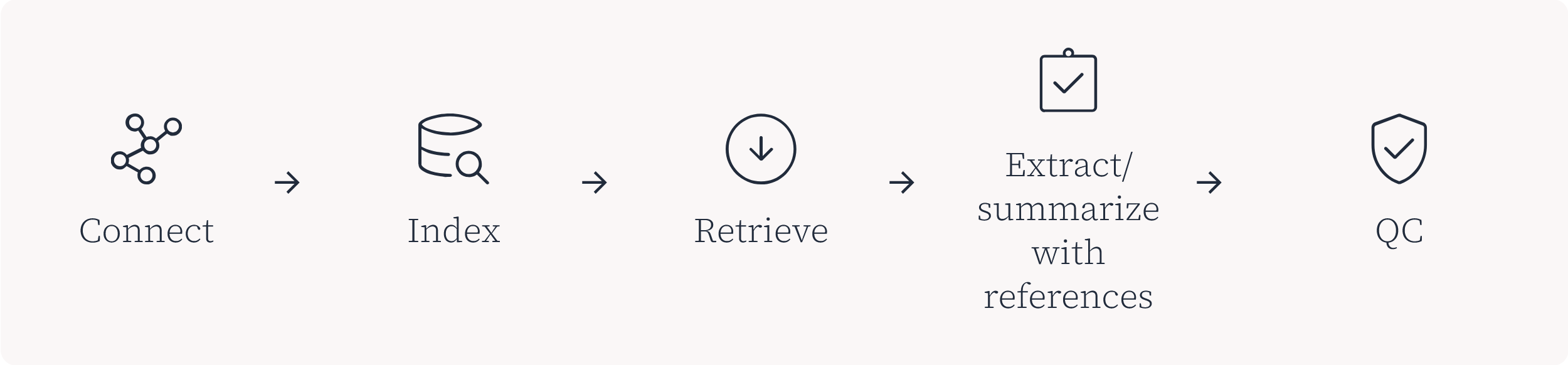
In practical terms, this means the same best-practice blueprint described above, connect → index → retrieve → extract/summarize with references → QC, can be implemented in a single environment designed for drug-development workflows and traceable outputs.
Connect

Index

Retrieve

Extract/
summarize with references

QC

Activate Your Drug Development Data with Certara.AI

Connect siloed systems, index unstructured content, and deploy reference-backed GenAI workflows securely and at scale.

See how Certara.AI powers governed, AI-ready data fabrics.

Learn moreSchedule a demo

Author

Sean McGee, MS

Director of Product, Certara

Sean McGee is currently the Director of Product at Certara, working within the Certara artificial intelligence (AI) group. Throughout his career, Mr. McGee has supported the strategy and go-to-market motions of various software technologies, including Benchling’s laboratory informatics platform and the AI and molecular modeling and simulation offerings for Dassault Systèmes BIOVIA brand. In his role with Certara, Mr. McGee guides the development of new AI-focused use cases which maximize the benefits of the Certara AI and broader company portfolio.

Mr. McGee completed his Master of Science at the University of Notre Dame exploring the scientific and commercial applications of medical devices designed to aid in the identification of child abuse.


Frequently asked questions about Data Fabrics in Pharma

Is a data fabric the same as a data lake?

No. A data lake centralizes data storage in a single repository. A data fabric in pharma connects data across distributed systems without requiring everything to be moved or duplicated.

A data fabric focuses on unified discovery, governance, and controlled access across environments. A data lake focuses on centralized storage.

When should a pharma organization implement a data fabric?

A data fabric in life sciences is most valuable when data is spread across multiple validated systems, repositories, and document sources that cannot easily be consolidated.

Common triggers include:

  • Cross-study evidence search challenges
  • Slow clinical or regulatory review workflows
  • Heavy reliance on unstructured documents
  • The need for AI-ready, permissions-aware retrieval

Organizations often begin with a clinical data fabric (CDF) and expand over time.

Is a clinical data fabric different from a general data fabric?

A clinical data fabric (CDF) is a focused implementation of a broader data fabric in pharma. The architecture principles remain the same, but the connected sources are specific to clinical development.

A CDF typically connects clinical trial systems, safety data, regulatory documents, and related evidence sources while preserving governance and traceability.

Does a data fabric require moving or copying all data?

No. A core principle of a data fabric in life sciences is to connect and index data where it resides. In many cases, systems remain in place for validation, governance, or performance reasons.

The fabric provides a metadata-driven integration layer that enables unified search and access without unnecessary duplication.

How does a data fabric support generative AI in regulated environments?

Generative AI requires reliable context, clear permissions, and traceable outputs. A data fabric in pharma provides governed indexing, metadata, and permissions-aware retrieval.

When combined with retrieval-first workflows and reference-backed outputs, this approach supports faster drafting and analysis while maintaining reviewability and compliance.

Schedule a demo