


search

May 11, 2026

Pharmacokinetic data is rich and complex, but many pharmacokinetic data report​s struggle to turn it into clear, actionable insight. Dense tables, inconsistent figures, and disconnected conclusions force reviewers to interpret rather than understand. That is why effective PK reporting is essential.

Strong pharmacokinetic data reporting goes beyond presenting results. It guides the reader through a clear, logical story from raw data to meaningful conclusions, helping both scientists and decision makers quickly grasp what matters and why.

1. Build a clear structure for your pharmacokinetic report

A well structured PK report follows a clear, logical progression that mirrors the scientific process and builds evidence before interpretation:

  • Observations: What was measured?
  • PK parameters: What are the key metrics?
  • Statistical analysis: Are there differences between groups?
  • Discussion: What do the results mean?
  • Conclusions: Why do they matter?

This step by step flow keeps pharmacokinetic data reporting clear, complete, and easy to follow.

2. Present data that speaks for itself

Effective pharmacokinetic data reporting starts with clear raw data presentation. Show concentration time profiles on both linear and semi log scales to capture peaks and elimination patterns.

Overlay or spaghetti plots reveal variability across subjects, combining individual profiles with a mean trend to highlight consistency and outliers.

Tables should be clean and consistent, with clear units and logical structure so the data speaks for itself with minimal explanation. This is a key principle across high quality Pharmacokinetic (PK) reports.

3. Turn data into meaningful metrics

Once raw data is presented, PK parameters like Cmax, AUC, and half life translate profiles into clear metrics, shown at both individual and summary levels.

Use appropriate statistics: means and variability for continuous data, often geometric for skewed data, and medians with ranges for discrete variables like Tmax.

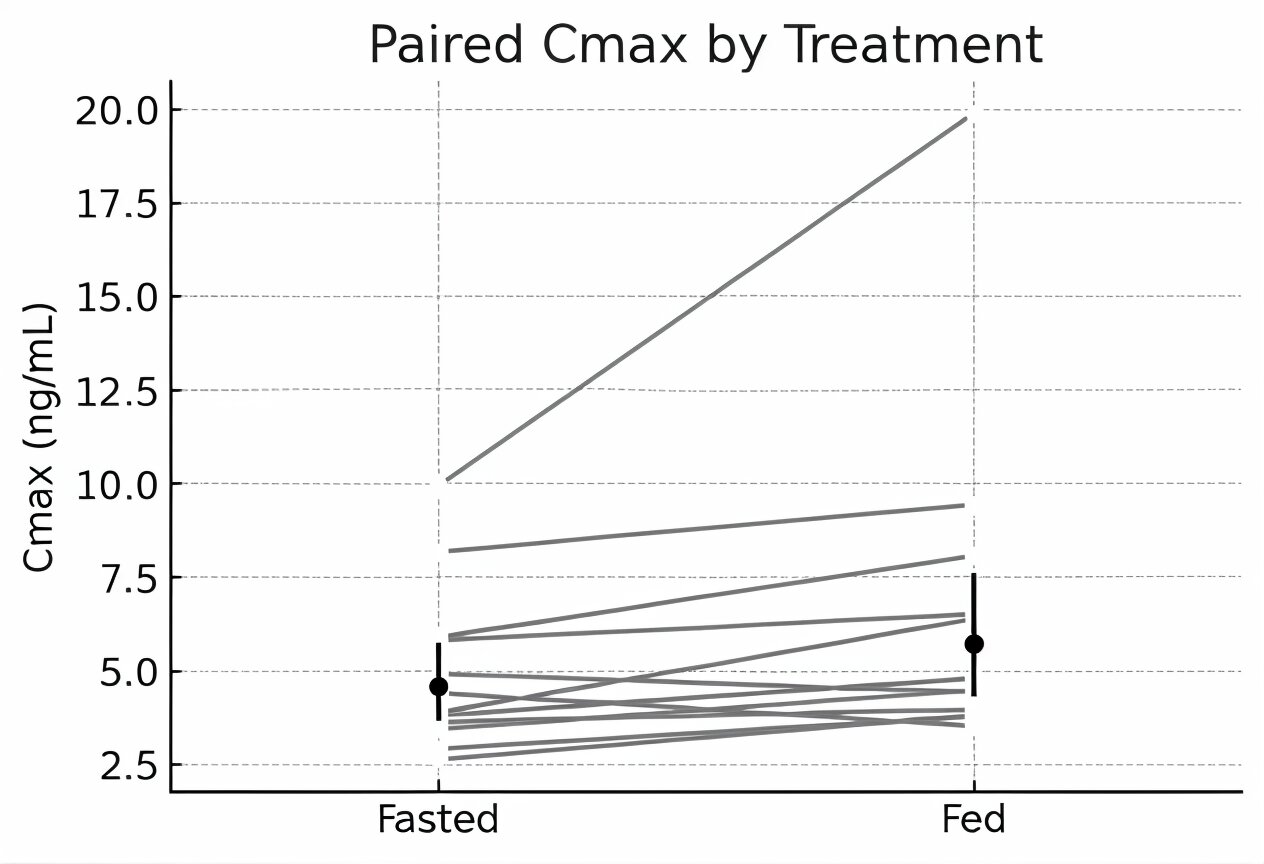
Visuals such as box plots, paired comparisons, and forest plots help reveal trends and differences beyond tables.

Paired line plot of Cmax (ng/mL) for Fasted vs Fed conditions. Most subjects show slight increases from Fasted to Fed, with one large increase. Mean Cmax (black dots with error bars) is higher in the Fed condition.

4. Connect analysis to insight

Statistical analysis should confirm what the data suggests, not replace it. Confidence intervals, ratios, and p values add rigor, but must be clearly linked to the observed data. This combination of visual evidence and statistical validation strengthens pharmacokinetic data reporting.

The discussion brings everything together by explaining implications, comparing findings to expectations, and acknowledging variability or limitations. The conclusion then distills the key takeaway into a clear, concise answer to the original question.

Why PK reporting matters

At its core, PK reporting is about communication. A well crafted report transforms complex datasets into a coherent narrative that supports decision making. By focusing on structure, clarity, and appropriate use of visuals and statistics, teams can move from simply presenting data to delivering real insight.

Looking to streamline your workflow?

Certara’s solutions can help you create consistent, high quality PK reports faster. With TFL Studio, you can automate tables, figures, and listings, while AI PK Reports transforms outputs into draft reports in minutes.


Learn more about TFL StudioExplore AI PK Reports

Author

Sebastian Kuechenmeister

Associate Director

Sebastian Küchenmeister joined Certara in 2022. He is a creative marketing professional with extensive expertise in multiple marketing disciplines, campaign management, media planning and a passion for content creation and go-to market strategies. Mr. Küchenmeister earned a Bachelor of Arts degree in Political Science from the Humboldt University in Berlin, Germany.

Schedule a Demo of Phoenix Cloud

Discover how Phoenix Cloud frees research teams to focus on the science, with workflows that accelerate the path from ‘data in’ to ‘report out’.

Why Schedule a Demo? 

Experience the power of cloud-based PK/PD analysis firsthand.
Learn how Phoenix Cloud ensures compliance and simplifies workflows.
See how Certara’s solutions for rapid TFL creation, GenAI-powered reporting, and smarter data management can enhance your team’s productivity.