




search

April 22, 2026

A quantitative framework for ADC dose optimization

Antibody drug conjugates, or ADCs, are reshaping oncology drug development. But their promise comes with a fundamental challenge: ADC dose optimization, and regimen selection is no longer a linear decision.

Unlike traditional therapies, ADCs do not follow a simple more is better paradigm. Efficacy, safety, and tolerability are tightly linked, and often constrained within a narrow therapeutic window. Getting ADC dosing right is not just a clinical question; it is a strategic one.

Model informed drug development (MIDD) is increasingly central to answering it.

Moving beyond maximum tolerated dose

Historically, oncology development has centered on identifying the maximum tolerated dose, with the assumption that higher exposure would yield greater efficacy.

For ADCs, that assumption breaks down.

What is emerging instead is a more deliberate approach to antibody drug conjugates dose optimization:

  • Defining an optimal dose range rather than a single maximum dose
  • Recognizing that efficacy may plateau while toxicity continues to rise
  • Designing studies that generate the data needed to understand that balance early

As Khaled Benkali explains: “For ADCs, increasing dose does not always translate to better outcomes. The goal is to define the optimal dose range that balances efficacy and safety.”

This shift reflects a broader evolution in how dose is evaluated, one that prioritizes evidence over convention.

The reality of ADC complexity

ADCs are inherently multifaceted. The antibody, payload, and linker each influence how the therapy performs, and how risk emerges.

The same mechanisms that drive tumor cell killing can also contribute to toxicity, particularly when payload is released outside the intended target. The result is a narrow margin between benefit and risk, and a higher likelihood of suboptimal decisions if dose is not rigorously optimized.

This is why traditional, one-dimensional approaches to dose selection are no longer sufficient, and why ADC dose regimen optimization requires more integrated, data-driven strategies.

From data to decisions: A quantitative framework

Effective ADC dose optimization requires integrating multiple layers of evidence, pharmacokinetics, clinical response, safety, and patient variability, into a coherent framework.

Population PK (PopPK) and exposure response (ER) analyses play a central role in doing this.

A defining feature of ADCs is the need to account for multiple analytes, including intact antibody, total antibody, and free payload. Each contributes differently to clinical outcomes. The intact ADC is typically the primary driver of efficacy, while free payload exposure is more closely associated with toxicity.

As Eline van Maanen notes: “Understanding which analytes drive efficacy versus toxicity is critical. For ADCs, that often means looking beyond a single exposure metric.”

This enables a more precise understanding of where increasing dose adds value, and where it introduces unnecessary risk.

Mechanistic insight changes the conversation

Physiologically based pharmacokinetic modeling (PBPK) provides a deeper, mechanistic view of ADC disposition, particularly in understanding tissue distribution.

One of the most important insights is also one of the most overlooked: only a small fraction of an administered ADC dose reaches the tumor. The majority distributes across healthy tissues.

As Armin Sepp highlights: “Only a small fraction of the administered dose reaches the tumor. The majority distributes to healthy tissues, which is key to understanding toxicity.”

This reframes how developers think about targeting, efficacy, and safety, and reinforces the need for quantitative approaches to guide ADC dosing decisions.

Enabling smarter decisions across development

Model informed strategies are not confined to a single stage of development. They enable better decisions throughout:

  • Early clinical development, informing dose ranges and escalation strategies
  • Late-stage development, supporting robust dose justification for regulatory submissions
  • Special populations, where clinical data is limited but decisions still need to be made

As Felix Stader adds: “Modeling allows us to explore scenarios we cannot easily test in the clinic, from special populations to drug interactions.”

The value is not just in analysis, but in enabling forward-looking, evidence-based decisions across the full lifecycle of ADC dose optimization.

Final thoughts

The complexity of ADCs demands a different approach to dose selection, one that is integrated, quantitative, and grounded in a clear understanding of risk and benefit.

Model-informed strategies provide that foundation. They move development beyond assumptions and toward a more predictive, defensible framework for decision making, strengthening both ADC dose regimen optimization and overall development strategy.

To hear directly from Certara experts Khaled Benkali, Eline van Maanen, Armin Sepp, and Felix Stader, and explore how these strategies are applied in practice, watch the full webinar.

FAQs

Why is dose selection more complex for antibody–drug conjugates (ADCs) compared to traditional oncology therapies?

ADCs combine an antibody, linker, and cytotoxic payload, each contributing to both efficacy and toxicity. Unlike traditional therapies, increasing dose does not necessarily improve outcomes, as efficacy may plateau while toxicity continues to rise. This creates a narrow therapeutic window, requiring a more nuanced, data-driven approach to antibody drug conjugates dose optimization.

How do population PK and exposure–response analyses support ADC dose optimization?

Population pharmacokinetic (PopPK) and exposure–response (ER) analyses help quantify the relationship between drug exposure, efficacy, and safety. For ADCs, multiple analytes such as intact antibody, total antibody, and free payload must be evaluated, as each impacts outcomes differently. These approaches enable developers to identify which exposures drive benefit versus risk and support more informed ADC dosing and regimen decisions.

What role does physiologically based pharmacokinetic (PBPK) modeling play in ADC development?

PBPK modeling provides mechanistic insight into how ADCs distribute throughout the body, including tumors and healthy tissues. This understanding supports better dose selection, informs study design, and strengthens ADC dose optimization strategies.

How do model-informed strategies support regulatory decision-making for ADCs?

Model-informed drug development (MIDD) approaches are increasingly expected by regulators to support dose justification and overall development strategy. Integrating PopPK, exposure–response, and PBPK modeling provides a structured, evidence-based framework aligned with ICH M15, enabling more transparent and defensible submissions.

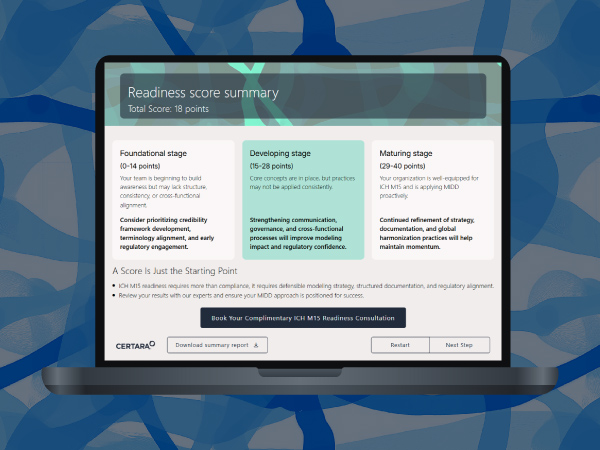
To better understand how your current approach aligns with these expectations, explore our interactive ICH M15 scorecard to assess readiness and identify areas to strengthen your MIDD strategy.

Optimize ADC development with model-informed strategies

As antibody–drug conjugates (ADCs) advance through development, dose and regimen decisions become increasingly complex. Certara’s integrated modeling and simulation capabilities combine population pharmacokinetics, exposure–response analysis, and physiologically based pharmacokinetic (PBPK) modeling to support confident, data-driven decisions across every stage of development.

Whether you are defining dose ranges in early studies or preparing for regulatory submission, our experts help translate data into actionable insights that balance efficacy and safety.


Discuss your ADC program

Author

Erika Brooks

Marketing Director, Quantitative Science Services

With over 22 years of experience in hospitals, health systems, associations, life sciences, physician practices, and suppliers, Erika is an experienced marketing strategist and supports the Quantitative Science Services offering with Go-to market planning and execution.

Contact us