



May 1, 2026
Mass spectrometry schematic
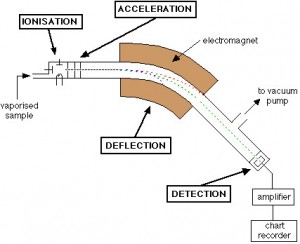
Mass spectrometry is a detection method that relies on the mass-to-charge ratio of a compound. Following the chromatographic separation, molecules are ionized using an energy source. These ionized molecules then pass through a set of magnets, which further separates molecules based on their mass-to-charge ratio. Detection is performed based on charged particles striking a detector and creating a current. The detector only detects charges and cannot differentiate molecules based on mass. The magnetic separation provides the selectivity of the method. Thus, two molecules that are ionized at the same time, but have different masses can be detected independently using MS detection. Similarly, two molecules that are ionized at the same time and have the same masses, but have different charges, can be detected independently using MS detection.
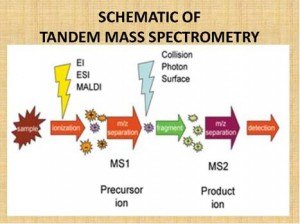
Further specificity can be obtained when multiple ionization events occur. The second ionization process fragments the molecules into pieces that each have their own mass-to-charge ratio. These pieces are called daughter ions and can be detected. Each parent molecule fragments in a predictable fashion. Thus, even if two parent molecules have the same mass-to-charge ratio, if they break into different daughter ions, these can be differentiated. The multiple ionization event method is called tandem mass spectrometry (or MS/MS). The MS/MS technology is only used when a single ionization is not adequate to achieve the desired sensitivity.
Tandem mass spectrometry
The unique specificity of mass spectrometry detection permits more flexibility with the liquid chromatographic separations. Because molecules can be uniquely identified by MS, even if they exit chromatography together, the liquid chromatography becomes less important for LC/MS/MS than it is for HPLC/UV. Often, crude chromatographic techniques are adequate for LC/MS/MS, where complete separation is required for HPLC/UV. The results are that run times can be much shorter with LC/MS/MS, and precision and accuracy are increased. It really is the best of both worlds!
The primary challenges in MS detection are controlling the ionization process. Problems with incomplete ionization and interference can lead to poor precision and accuracy with the MS detector. These problems can be resolved with a variety of different ionization techniques, solvents, and even chromatographic separations. Additional techniques include time of flight MS, ion capture MS, and others. These special methods use different MS detector setups to improve the precision, accuracy, and sensitivity of MS detection.
It is unlikely that you will be an expert in mass spectrometry after reading this post. However, you should be able to understand the fundamental tenets of the technology and how it is used in bioanalysis.

Why Performing Key CMC Activities Early Can Aid De-risking Your Drug Development Program
This white paper focuses on best practices for developing a CMC strategy for orally administered small molecule drugs.

Deven Shah, BPharm, PhD
VP, Chemistry, Manufacturing, & ControlsDr. Shah leads Certara’s CMC team with over two decades of experience in formulation development, drug delivery, and regulatory interactions.
This blog was originally published in July 2014 and has been updated for accuracy.
Learn more about our Early Development offering
Expert Support at Every Stage from Candidate Selection through Phase 1

FAQs
How is LC/MS/MS used in drug development?
Here are some applications of LC/MS/MS in developing a new therapy.
- Pharmacokinetics (PK) & ADME: LC-MS/MS is essential for assessing absorption, distribution, metabolism, and excretion (ADME) profiles of investigational drugs.
- Bioanalysis and Regulatory Compliance: It offers high-throughput, quantitative analysis of drug candidates in biological fluids under GLP (Good Laboratory Practice) guidelines.
- Biomarker Discovery & Validation: LC/MS/MS is used to identify and validate novel biomarkers to measure therapeutic responses in patients.
- Metabolite Profiling & Drug Metabolism: Studies identify active drug metabolites and potential toxicological risks early in development.
- Immunogenicity Testing: Immunogenicity (IG) is defined by the FDA as the propensity of the therapy to generate immune responses to itself and to related therapies or to induce immunologically-related adverse clinical events. LC-MS/MS can be used to detect anti-drug antibodies (ADA) for biopharmaceuticals, thus aiding formulation strategies.
How do Certara’s experts support bioanalytical assay development?
We support our clients throughout the lifecycle of their projects for bioanalytical assay development of diverse modalities encompassing small molecules, peptides, mAbs, bispecific antibodies, oligonucleotides, antibody-drug conjugates (ADCs), and cell therapies. We help with CRO selection as well as oversight of the bioanalytical method development & validation, sample analysis protocols, and analytical report reviews. We provide bioanalytical assay development support for both preclinical and clinical stages and ensure that a phase-appropriate strategy is implemented for relevant PK/PD biomarkers and immunogenicity evaluation. We also provide support for regulatory strategy and compiling required regulatory writing documentation such as the Integrated Summary of Immunogenicity (ISI).
What happens if a program neglects their clinical PK/PD/ADA assay development?
Not developing suitable bioanalytical assays (e.g. pharmacokinetics (PK), anti-drug antibody/neutralizing antibody (ADA/nAb), pharmacodynamic (PD) Biomarkers, and Immune Response Functional Assays) in a timely manner has huge implications on the product’s PK, efficacy, safety, and regulatory acceptability. If robust validated assays aren’t available on time, there is a risk of not being able to determine PK for enabling dose escalation, deriving robust PK-PD modeling, understanding immunogenicity risks, or conducting comparability evaluation for any implemented changes. This in turn can require repeating non-clinical or clinical studies, leading to significant delays to the project timelines (~12-18 months or more) and incurring significantly higher costs. This also carries the risk of not meeting the regulatory standards for the bioanalytical data package resulting in increased scrutiny by the regulatory agencies for the IND/NDA/BLA submissions. There could be major review questions delaying the approvals or resulting in clinical hold.
Contact us our Early Development experts
You May Also Like