


search

May 8, 2026

As clinical trials advance into later study phases, the levels of complexity significantly increase. Larger volumes of diverse data, more stringent regulatory requirements, and rising numbers of stakeholders all contribute to this added complexity. For contract research organizations (CROs), managing this complexity is crucial to delivering against sponsor timelines, and ensuring submission success for clients.

Pinnacle 21 Enterprise is purpose-built to help CROs scale their data validation, collaboration, and submission workflows – especially in Phase II and Phase III trials where the stakes are highest.

In this blog, we will explore:

  • How CROs support late phase clinical data validation
  • Key challenges CROs face when preparing Phase II and III trials
  • How Pinnacle 21 Enterprise addresses and overcomes these challenges

The role of CROs in Phase II and Phase III studies

As studies progress into Phase II and III, submission readiness becomes a critical focus for CROs. Ensuring datasets are accurate, consistent, and compliant with regulatory standards is essential for sponsor submissions.

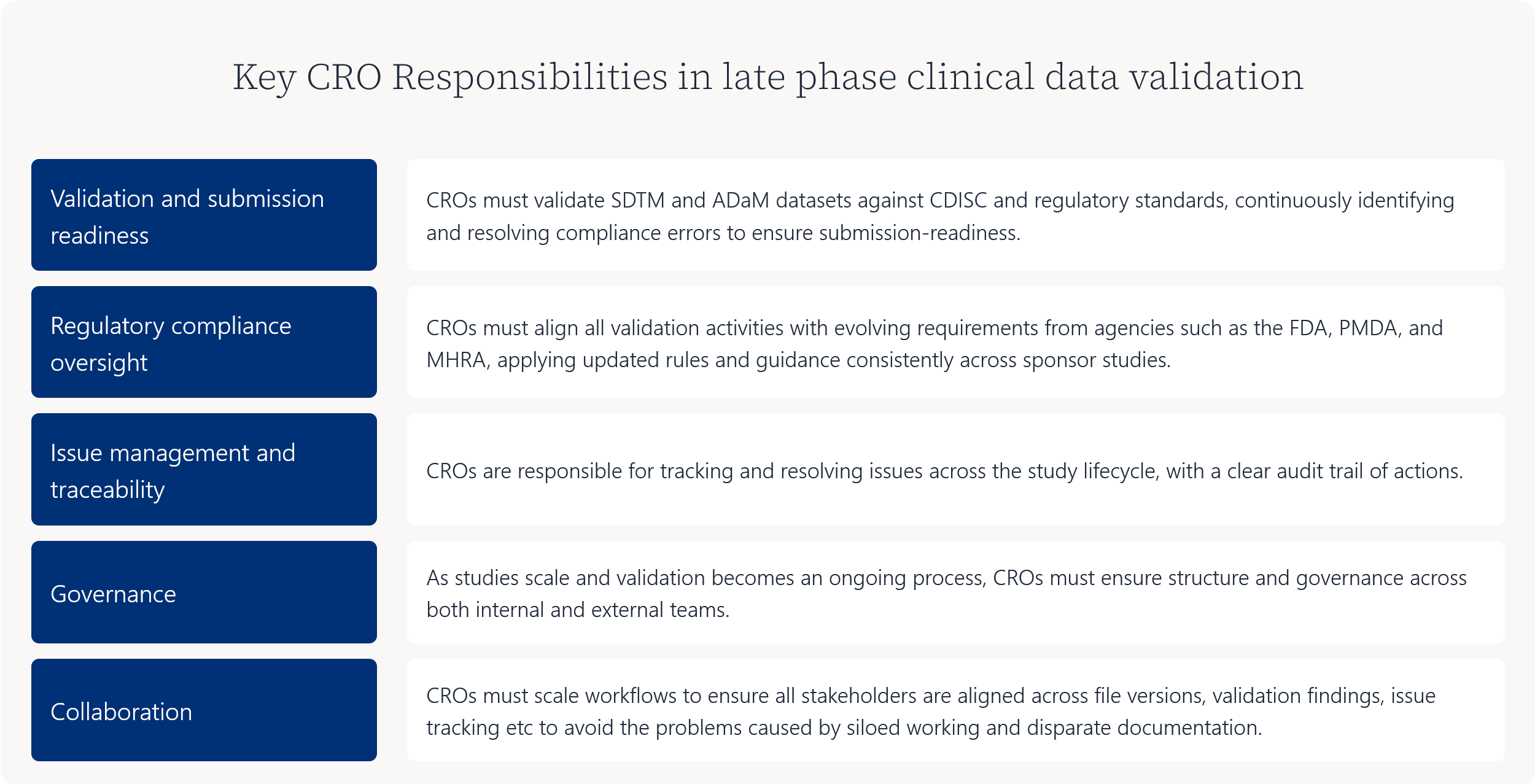
Key CRO Responsibilities in late phase clinical data validation

responsibility wdt_ID details
Validation and submission readiness 1 CROs must validate SDTM and ADaM datasets against CDISC and regulatory standards, continuously identifying and resolving compliance errors to ensure submission-readiness.
Regulatory compliance oversight 7 CROs must align all validation activities with evolving requirements from agencies such as the FDA, PMDA, and MHRA, applying updated rules and guidance consistently across sponsor studies.
Issue management and traceability 8 CROs are responsible for tracking and resolving issues across the study lifecycle, with a clear audit trail of actions.
Governance 9 As studies scale and validation becomes an ongoing process, CROs must ensure structure and governance across both internal and external teams.
Collaboration 10 CROs must scale workflows to ensure all stakeholders are aligned across file versions, validation findings, issue tracking etc to avoid the problems caused by siloed working and disparate documentation.
Key challenges late-phase CROs face in clinical data validation for sponsors

Increasing data volume and complexity

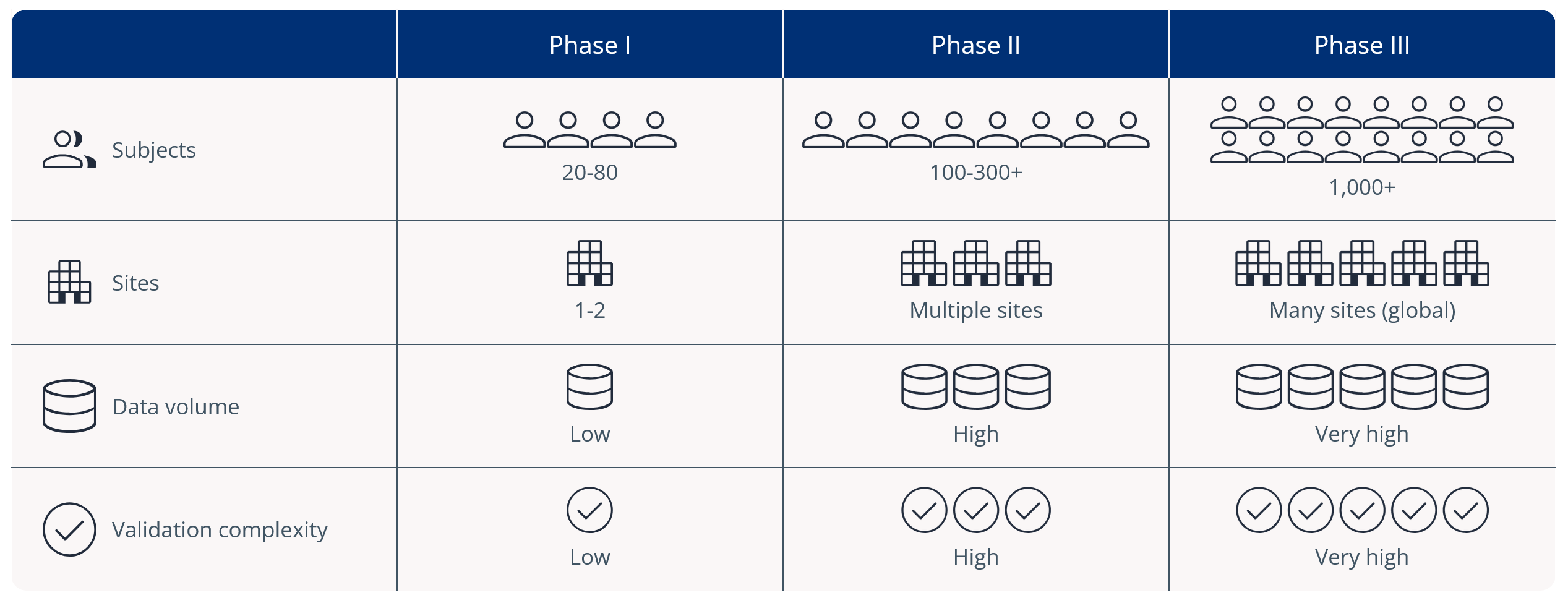
As studies progress into Phase II and III, validation complexity doesn’t just increase; it multiplies. Larger SDTM and ADaM datasets drive a higher volume of validation issues. Expanding cross-domain relationships and an increased number of sites add further dependencies and coordination challenges.

For example, validation can scale from around 8 datasets and 50 rules in early studies to over 25 datasets and more than 200 rules with cross-domain checks in Phase II.

As studies scale, metadata quality also becomes a key driver of overall validation quality. For example, small inconsistencies across define.xml or controlled terminology can trigger multiple downstream issues.

These factors significantly increase workload and coordination requirements: it becomes increasingly difficult to resolve validation issues and perform validation efficiently. Ultimately, this slows validation cycles and threatens consistent data quality across sponsor programs.


Phase I
Phase II
Phase III
Subjects
Sites
Data volume
Validation complexity
20-80
1-2
Low
Low
100-300+
Multiple sites
High
High
1,000+
Many sites (global)
Very high
Very high

Lack of centralized validation & issue management

Without centralized late phase clinical data validation and issue tracking, CROs lack visibility between validation runs. Teams often rely on spreadsheets and manual assignment, making it difficult to track progress and understand exactly what has been changed between versions, and why. At best, this results in inefficient tracking and increased manual effort. At worst, this increases the risk of delays across the validation lifecycle.

Fragmented collaboration & lack of traceability

In late-phase trials, data flows across multiple teams and organizations, making coordination and visibility crucial. Without centralized collaboration, communication becomes siloed, leading to misalignment, duplicated effort, and delays in resolution.

Increased regulatory scrutiny requires full traceability across the data lifecycle. Without a centralized system, demonstrating a complete audit trail across sponsor studies becomes difficult – undermining inspection readiness.

Tight submission timelines

Phase III trials sit on the critical path to regulatory approval, leaving little margin for delays. As datasets grow in size and complexity, running validation late in the process can create bottlenecks and increase risk. Without early and continuous validation workflows, CROs often struggle to keep pace with sponsor submission deadlines.

How CROs can overcome these issues with Pinnacle 21 Enterprise

To manage late-phase study validation effectively at this scale, CROs require more than tools; they need centralized validation outputs, integrated issue tracking, metadata-driven processes, and full auditability. This is where Pinnacle 21 Enterprise plays a key role, bringing these capabilities together in a centralized, scalable platform.

Scalable, enterprise-grade validation

Enterprise is built to support CRO-scale operations and is particularly suited to the scale and complexity of late-phase clinical trials. It enables advanced validation across large volumes of studies within a secure, cloud-based environment. The platform uses centrally managed, configurable rule sets aligned with the latest FDA, PMDA, and CDISC standards – ensuring all users validate within a consistent, regulator-aligned framework.

  • Ensures alignment with the latest validation engines, standards, and global regulatory rules
  • Provides full validation history and report comparisons for complete traceability across runs
  • Supports validation across multiple engines and pre-configured medical dictionaries, including MedDRA, WHODrug, and MED-RT

By reducing repetitive manual effort, CROs can significantly improve operational efficiency and instead focus on providing compliant, consistent data deliverables to sponsors.
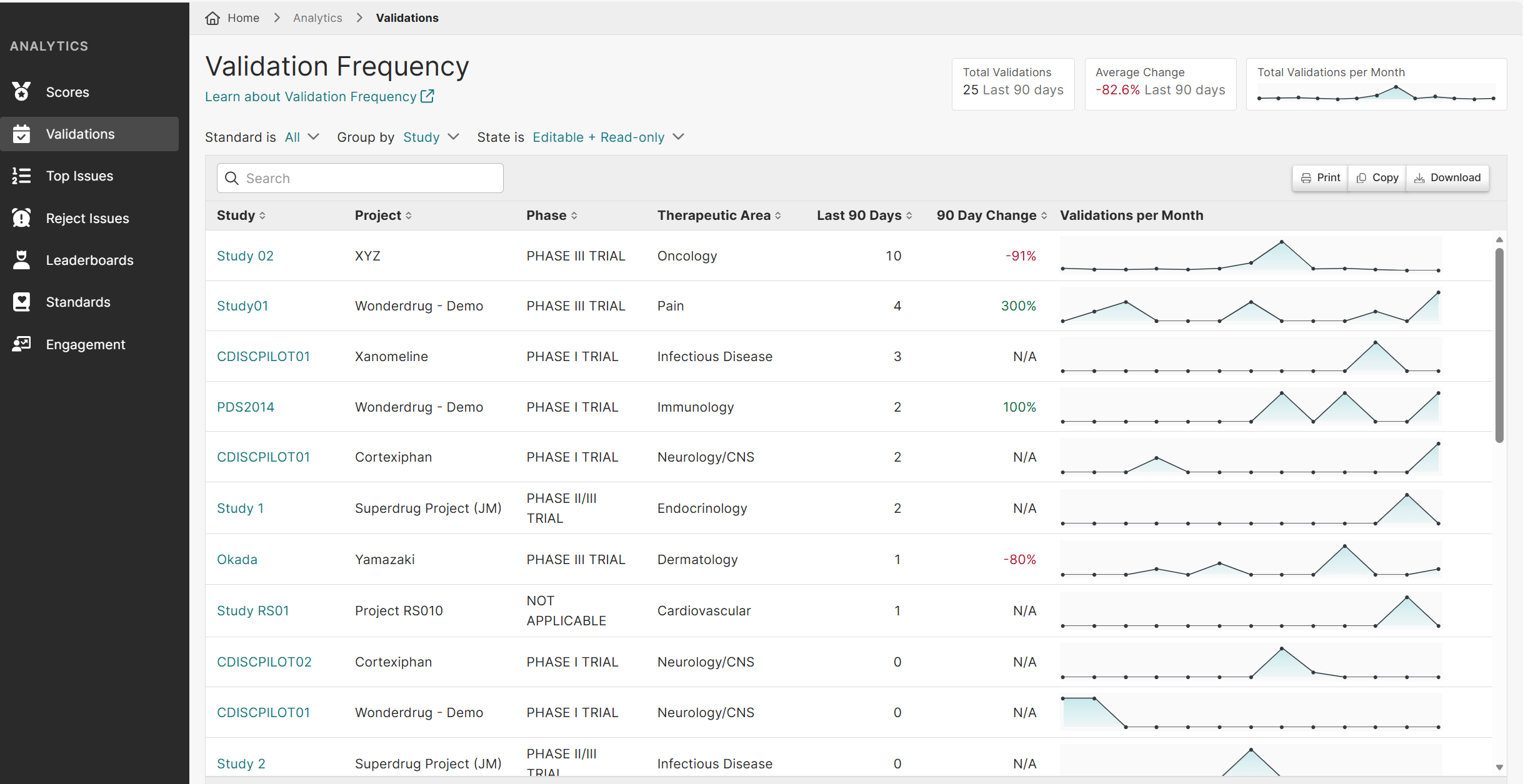
validation dashboard in Pinnacle 21 Enterprise

Streamlined issue management

Enterprise centralizes validation outputs and issue management in a single, shared environment. This ensures seamless collaboration across sponsor and CRO teams, and allows for earlier issue detection. In late-phase trials, where multiple stakeholders, studies and timelines must align, this level of coordination and visibility is key to swift issue resolution.

  • Maintains issue history and context across validation runs
    • Complete audit trail with end-to-end traceability across validation findings, issue status, ownership, and resolution history
    • Early issue detection with continuous validation
  • Reusable ‘fix tips’ with pre-written explanations
    • The ability to create sponsor-specific fix tips (10 explanations per rule) maintains data quality and consistency across studies
  • Real-time visibility and reporting across studies to improve oversight and decision-making

By unifying issue management workflows, CROs can reduce time-consuming manual work, improve transparency with sponsors, and achieve faster progression toward submission.
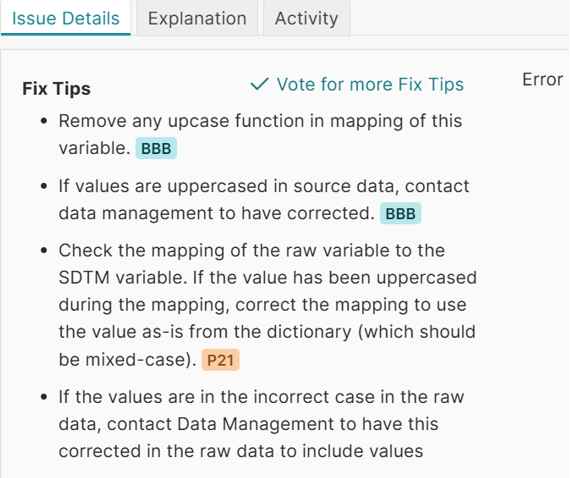
clinical data issue management

Consistent data quality across client studies

Enterprise allows CROs to maintain consistent, high-quality data across multiple sponsor studies by standardizing validation workflows. In late-phase trials, where larger datasets, parallel studies and diverse requirements converge, this is essential to avoid downstream inconsistencies and submission risk.

  • Centralized rule governance ensures consistent application of CDISC and sponsor-specific standards across studies
  • Leverages metadata-driven processes to standardize dataset structures, variables, and controlled terminology across studies
  • Provides visibility into data quality trends across sponsor programs, enabling proactive quality management

This standardized, governed approach allows late phase CROs to deliver reliable, submission-ready datasets across client programs – even in the most complex late-phase environments.

Accelerated submission readiness for sponsors

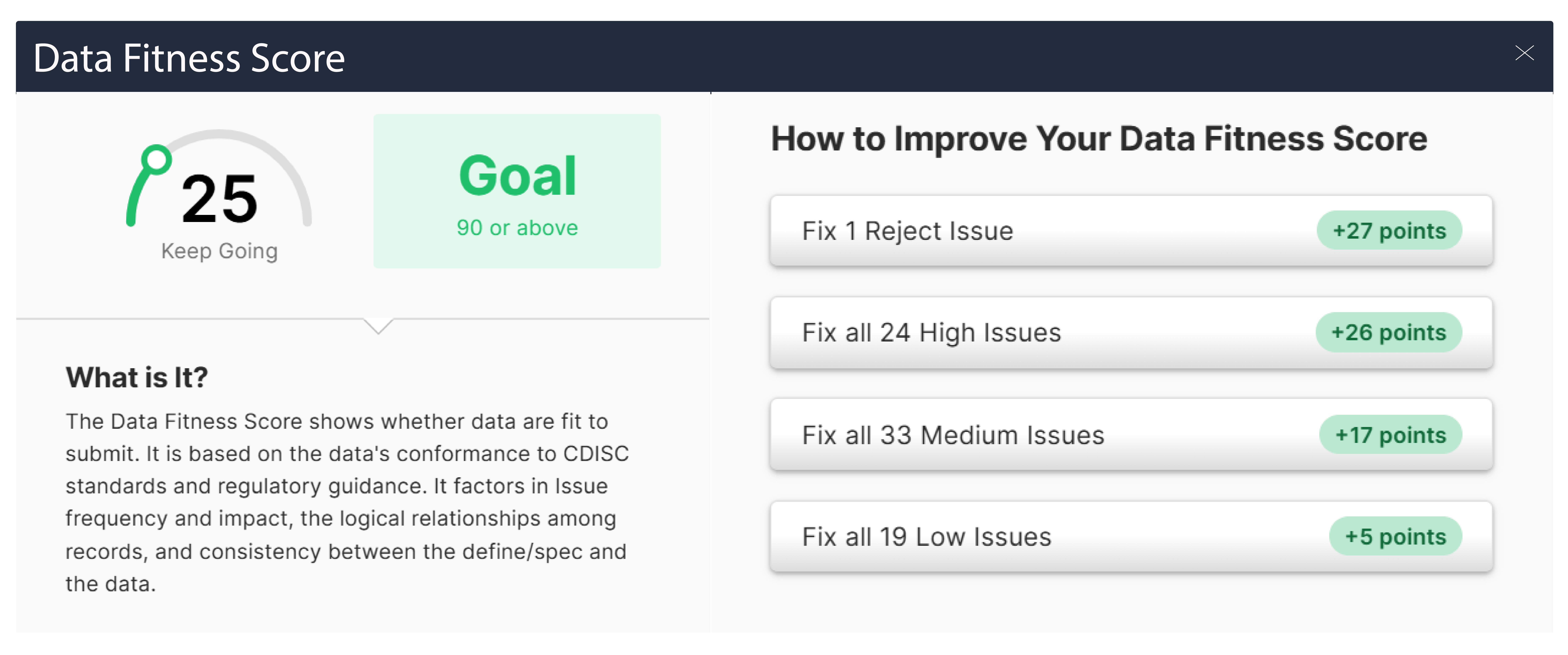
Enterprise accelerates submission readiness by demonstrating measurable insight into data quality through ‘data fitness scores’ and embedded guidance. For late phase CROs, where timelines are tight and submission-readiness is decisive, this offers the insights needed to quickly resolve non-compliance issues.

  • Provides measurable submission readiness indicators, ‘data fitness scores,’ with insight into priority fixes that will most impact readiness
  • Embedded guidance explains how to resolve validation issues, enabling faster resolution

This data-driven approach allows CROs to focus effort where it matters most in late phase clinical data validation, improving audit readiness for sponsors.

Summary and next steps

As clinical trials advance into Phase II and III, CROs must navigate increased data complexities, while delivering validation assurance and meeting sponsor submission deadlines.

Pinnacle 21 Enterprise addresses these challenges with advanced validation and issue management capabilities, allowing CROs to manage complexity at scale. It also supports streamlined collaboration, full traceability, and guided submission-readiness to ensure high-quality, compliant deliverables. For late phase CROs, the value is three-fold:

  1. Improved sponsor outcomes
  2. Operational efficiencies
  3. Competitive advantage

CROs save time and cost, while building greater sponsor trust through the reliable delivery of high-quality submission packages – ultimately creating a clear competitive advantage in a crowded market.

Average time saved with Pinnacle 21 Enterprise

240 hours
saved with P21E — Simple Study

536 hours
saved with P21E — Complex Study

Author

Jen Manzi

Jen Manzi

Subject Matter Expert and User Advocate, Pinnacle 21 by Certara

Jen Manzi is a Subject Matter Expert and User Advocate at Pinnacle 21. She has over 20 years of Pharma/Life Sciences industry experience in Clinical Trials and Safety Data Management. Jen has held various roles within these areas, including eCRF Programmer, SDTM Delivery Lead, Product Owner and Programmer of Batch Processes, Vendor Relationship Manager, Program and Process Improvement Manager, and Validation Lead.

Deliver compliance assurance for every sponsor

Learn more about how CROs can effectively manage submission complexity at scale with Pinnacle 21 Enterprise.

Pinnacle 21 Enterprise for CROs
Pinnacle 21 by Certara

Make an inquiry about Pinnacle 21 Enterprise

Pinnacle 21 Enterprise builds on Community’s core validation capabilities with:

Advanced validation capabilities & alignment with latest validation engines
Enterprise-level governance
Issue tracking, prioritization and submission readiness guidance
Centralized collaboration and oversight

Make an inquiry to learn how your organization can benefit from reduced risk, increased quality, and guided submission readiness with Pinnacle 21 Enterprise.


FAQs

Why are Phase II and III trials more complex than Phase I?

Phase II and III trials are more complex because they involve larger patient populations, more endpoints, and multiple sites. For a late phase CRO, this significantly increases data volume and introduces more cross-domain dependencies, making late phase clinical data validation and overall late phase clinical data management far more demanding.

What is CRO data management and why is it critical in late-phase trials?

CRO data management refers to the processes and systems used by contract research organizations to collect, validate, standardize, and prepare clinical trial data for analysis and regulatory submission. In late-phase trials, effective CRO regulatory compliance tools are essential due to the scale and complexity of the data involved. They ultimately enable high-quality, compliant datasets that support reliable results and timely submissions.

What is the biggest data management challenge for CROs in late-phase trials?

For a late phase CRO, the biggest challenge is managing large, complex datasets while maintaining consistency, quality, and compliance under tight timelines. Effective late phase clinical data validation is critical, as increasing data volume and validation rules can quickly lead to inefficiencies and delays.

How does Pinnacle 21 Enterprise improve submission readiness?

Pinnacle 21 Enterprise supports late phase clinical data validation by enabling continuous validation, early issue detection, and standardized workflows. For a late phase CRO, this improves data quality and reduces last-minute delays, while supporting stronger regulatory alignment through advanced CRO regulatory compliance tools. Learn more about how Pinnacle 21 Enterprise supports submission readiness for CROs in this fact sheet: https://www.certara.com/fact-sheet/how-to-improve-cro-data-management/

Can Pinnacle 21 Enterprise support multiple sponsors?

Yes. Pinnacle 21 Enterprise enables a late phase CRO to manage multiple studies and sponsors simultaneously with consistent rule application and scalable processes. This ensures efficient late phase clinical data validation across programs while maintaining high standards of quality and compliance. Learn how CROs can scale efficiently while maximizing validation assurance in this blog: https://www.certara.com/blog/platforms-for-collaboration-between-sponsors-and-cros-5-ways-cros-can-scale-efficiently-while-maximizing-validation-assurance/


This is custom heading element

This is custom heading element

Lorem ipsum dolor sit amet consectetur. Donec diam risus volutpat tempor. Massa accumsan aliquam nibh tortor.Lorem ipsum dolor sit amet consectetur. Donec diam risus volutpat tempor.

Button CTA

This is custom heading element

Lorem ipsum dolor sit amet consectetur. Donec diam risus volutpat tempor. Massa accumsan aliquam nibh tortor.Lorem ipsum dolor sit amet consectetur. Donec diam risus volutpat tempor.

Button CTA

This is custom heading element

Lorem ipsum dolor sit amet consectetur. Donec diam risus volutpat tempor. Massa accumsan aliquam nibh tortor.Lorem ipsum dolor sit amet consectetur. Donec diam risus volutpat tempor.

Button CTA