



August 22, 2025
Over the past two decades in health economics and market access, I’ve seen firsthand how the way we communicate the value of a new drug or medical device can make or break a conversation. The science behind a product is essential, and how we present that science to decision-makers can also be critical. Interactive value messaging has become one of the most effective tools in our toolbox, especially when it is done with care.
Here are my top five ideas for making your interactive tools resonate, engage, and drive results.
1. Start with a Story, Not Just Data
Effective communication begins with a narrative that puts your audience front and center for the discussion. Instead of simply itemizing vital evidence, build a targeted story around it. Introduce the challenge from the stakeholder’s perspective, walk them through how your solution addresses it, and visualize the potential outcome. Whether you’re talking to a physician, payer, or policymaker, each needs to see how your message fits into their own unique scenario.
2. Tailor to the Audience – Focus and depth
Not every stakeholder wants or needs the same level of complexity. Emergency room directors may worry about resource allocation; Ministers of Health work to understand how choices affect their entire population; physicians may be seeking specific clinical results related to patient outcomes, and health system administrators may need to understand how a solution affects the overall budget. Customize your message to their priorities, their vocabulary, and their pain points. And don’t overlook the importance of a discussion leader who’s credible in that space. It makes a big difference.
3. Embrace Transparency and Clarity
A fast way to lose trust and interest is to present a “black box” calculation. Always show your work. When you ask users for input, like patient population size, explain exactly what’s needed and why. Provide default values from published literature, include assumptions, and always make references easy to access. Clarity earns confidence.
4. Engage Cross-Functional Experts Early
The most effective interactive tools are built through dynamic collaborations, not in silos. From early in the initiative, involve your experts inmedical , marketing, HEOR, regulatory, and digital. Their input shapes better strategy and smoother execution. Plus, those stakeholders have ownership and become champions who often advocate for the tool’s use and value across the organization.
5. Train, Refresh, and Celebrate Field Teams
A great tool requires users who are well-trained and confident with the interactive message. Invest in onboarding, discussion scripts, and regular refreshers. Support superusers who can then become local experts for the rest of the team. Remember to acknowledge their efforts – whether it’s sharing a success story or simply making time to thank the team and gather feedback. Empowered users are the key to long-term success.
When Storytelling Meets Strategy
Interactive value messaging has transformed how we communicate complex healthcare information. But technology alone isn’t enough. To create tools that are actively used – and that influence decisions – you need strategy, structure, empathy, and collaboration. Done well, these tools not only deliver your message; they open the door to meaningful conversations that can truly make a difference.
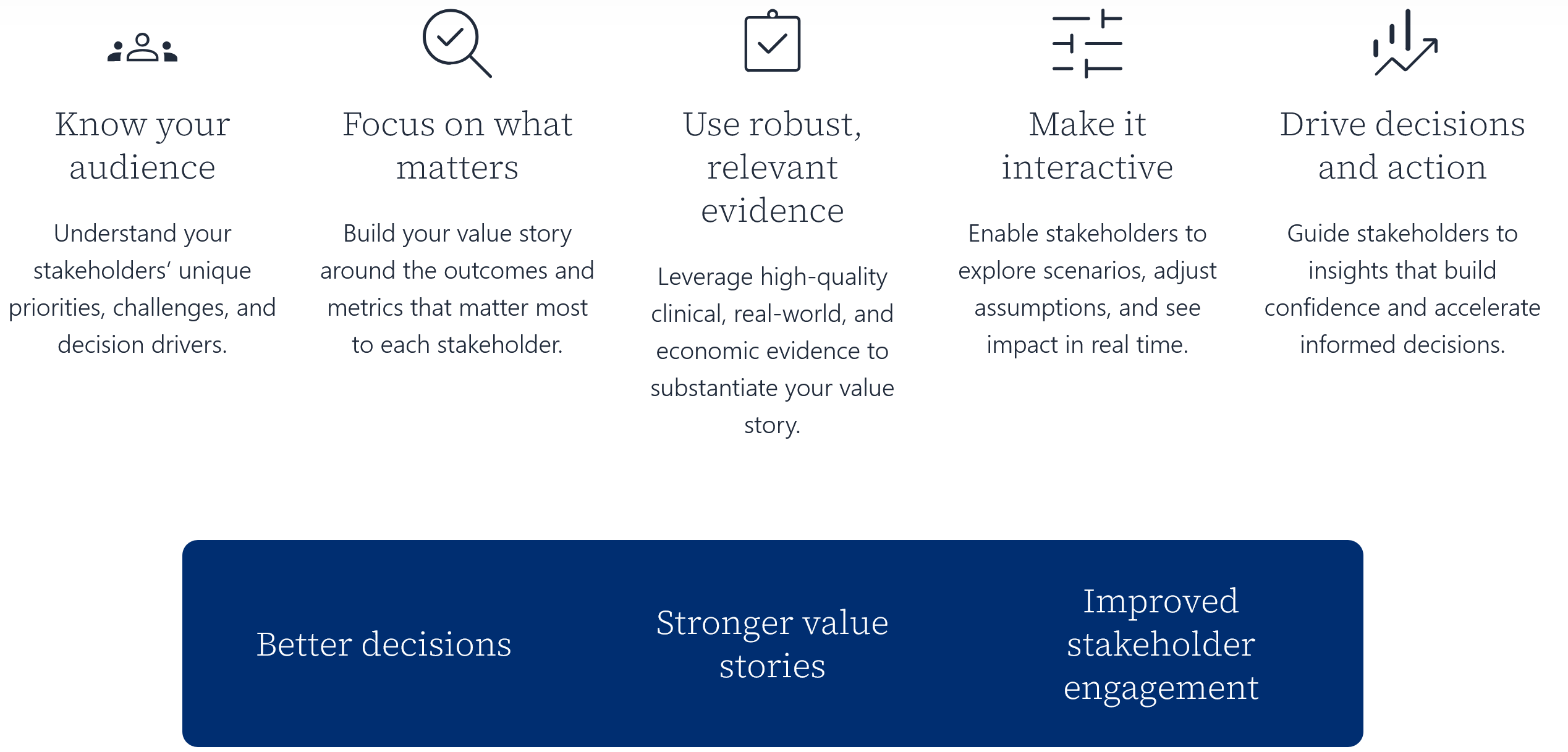

Know your audience
Understand your stakeholders’ unique priorities, challenges, and decision drivers.

Focus on what matters
Build your value story around the outcomes and metrics that matter most to each stakeholder.

Use robust, relevant evidence
Leverage high-quality clinical, real-world, and economic evidence to substantiate your value story.

Make it interactive
Enable stakeholders to explore scenarios, adjust assumptions, and see impact in real time.

Drive decisions and action
Guide stakeholders to insights that build confidence and accelerate informed decisions.
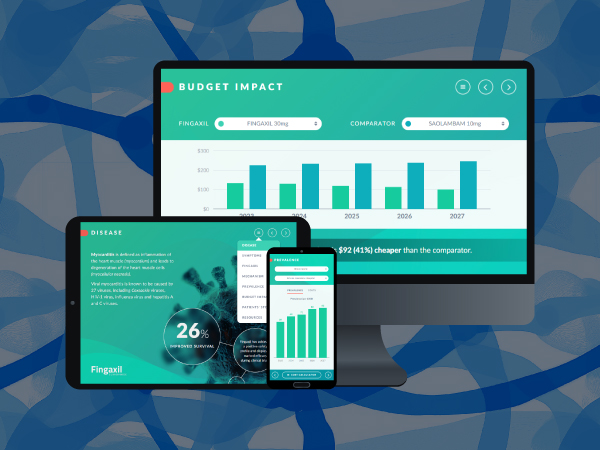
A practical guide to creating effective budget impact models
Whether you’re developing a new model or refining an existing one, this guide provides actionable recommendations for improving accuracy, transparency, and stakeholder confidence. Learn the foundations of successful budget impact modeling.

Cynthia Doucet has over 30 years’ experience in the healthcare industry (diagnostics and pharmaceuticals). Her roles have included Health Economics, Information Technology and serving as adjunct faculty at Northwestern’s Graduate School, and she has a special interest in evidence-based value messaging to support decisions affecting public health. Cynthia is currently President of OutcomeSynergy, Inc. and she and her husband Damon lead a small nonprofit providing food and educational toys to local families in the Chicago area.
FAQs
What is interactive value messaging and why is it important in healthcare?
Interactive value messaging enables healthcare organizations to communicate complex clinical, economic, and outcomes data through dynamic, user-driven experiences rather than static presentations. By allowing stakeholders to explore evidence relevant to their needs, interactive value messaging in market access supports more meaningful discussions with payers, formulary committees, and decision-makers. As healthcare evidence becomes increasingly complex, interactive value messaging life sciences teams use helps improve understanding, engagement, and evidence-based decision-making. Read more about the link between value communication and payer engagement in this blog: https://www.certara.com/blog/how-pharmaceutical-companies-can-engage-payers-digitally/
How does interactive value messaging improve market access communications?
Traditional presentations often deliver the same content to every audience, regardless of their priorities. interactive value messaging improves market access communications by allowing users to explore outcomes, economic evidence, and budget impact scenarios most relevant to their decision-making process. This approach strengthens stakeholder engagement, enhances evidence comprehension, and helps organizations tailor discussions without sacrificing message consistency. Effective interactive value messaging in market access can make value conversations more relevant and impactful, especially given the rising importance of value-based healthcare.
What role does health economics storytelling play in interactive value messaging?
Health economics storytelling transforms complex evidence into compelling narratives that stakeholders can easily understand and apply. When combined with interactive value messaging, organizations can present clinical and economic data in a way that is both engaging and evidence-driven. Strong health economics storytelling helps payers connect outcomes data with real-world healthcare challenges, making discussions more persuasive. This approach is increasingly valuable within interactive value messaging life sciences initiatives focused on demonstrating product value.
What are the biggest challenges when implementing interactive value messaging in life sciences?
Organizations often struggle with balancing scientific accuracy, regulatory compliance, and user-friendly design. Successful interactive value messaging life sciences programs require cross-functional collaboration among market access, medical affairs, HEOR, and commercial teams. Additional challenges include maintaining content consistency, managing evidence updates, and ensuring stakeholder relevance. Companies that establish clear governance processes and strong life sciences communications strategies are better positioned to achieve long-term success with interactive value messaging.
How can companies measure the success of interactive value messaging programs?
Success metrics should extend beyond presentation usage and include stakeholder engagement, content interaction rates, evidence utilization, and feedback quality. Organizations increasingly evaluate how interactive value messaging in market access influences payer discussions, value perception, and decision-making outcomes. Combining analytics with qualitative feedback provides a more complete picture of effectiveness. Strong life sciences communications, effective market access communications, and compelling health economics storytelling can all contribute to improved performance and stakeholder engagement. Learn how to deliver impactful value stories with BaseCase value communication software: https://www.certara.com/fact-sheet/basecase-turn-evidence-into-decisions-at-scale/
Make an inquiry
Ready to bring your value story to life? Make an inquiry to learn how BaseCase value communication software transforms complex economic models and clinical data into interactive, field-ready tools.