



search

June 5, 2026

For years, the pharmaceutical industry has treated national approval as the defining milestone of launch success. Secure pricing and reimbursement; publish the value dossier; brief the field teams; and expect uptake to follow.

But across Europe – and increasingly in other mature markets – the reality is far more complex. Even with strong national HTA outcomes, adoption varies dramatically across regions, networks, and hospitals at the sub-national level. Patients in one area gain rapid access, while those a few miles away wait months, or never receive the therapy at all.

This is not a tactical execution issue. It’s a structural shift in how health systems operate. The national launch model no longer reflects where decisions are made or how medicines reach patients. Today, commercial performance depends on mastering regional pharma market access: the subnational layer where funding, prioritization, and implementation decisions actually occur.

Companies that continue to rely on national-only strategies will see inconsistent uptake and missed opportunities. Those that build strong regional capabilities will outperform. And it’s not because they have better products. It’s because they understand how decisions are made in the real world.

In this blog, we explore why commercial success in pharma increasingly depends on winning at the regional and local level, including:

  • Why the traditional national launch model is no longer sufficient
  • How subnational market access dynamics shape real-world adoption
  • What defines an effective regional market access strategy today
  • How to operationalize localized market access for consistent uptake across regions

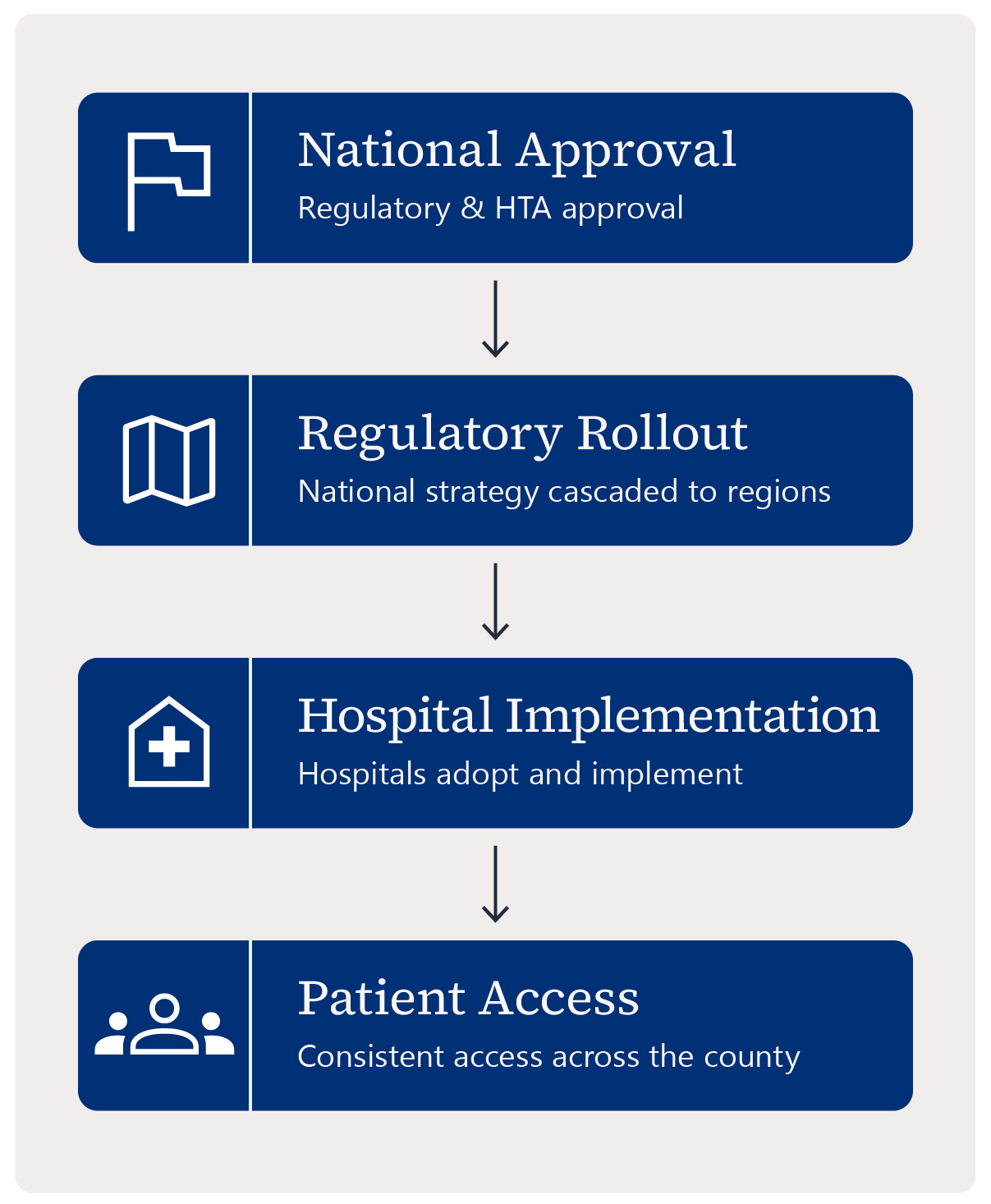
The traditional linear, centralized launch model: one size fits all

Flowchart showing four sequential steps in subnational market access: National Approval (regulatory & HTA approval), Regulatory Rollout (national strategy cascaded to regions), Hospital Implementation (hospitals adopt and implement), and Patient Access (consistent access across the county).

Why the national launch model is breaking down

The traditional launch model assumes a linear flow: national approval → regional adoption → hospital implementation → patient access.

Health systems have become more decentralized, more financially constrained, and more diversified. This results in a widening gap between national decisions and local execution.

Several forces are driving this shift:

Decentralized decision-making:

Regional authorities, integrated care systems, and hospital networks now hold significant influence over adoption and funding.

Budget pressure:

Regional bodies are accountable for financial sustainability, making them more selective about what they fund and when.

Local clinical autonomy

Hospitals increasingly define their own pathways, protocols, and formularies.

Subnational HTA:

Many countries require regional or hospital-level assessments even after national approval.

This creates a new competitive landscape: subnational market access. Even with a positive national decision, companies face a patchwork of local requirements, evidence expectations, and decision pathways.

The implication is clear: commercial success now depends on a strong regional market access strategy, not just national excellence.
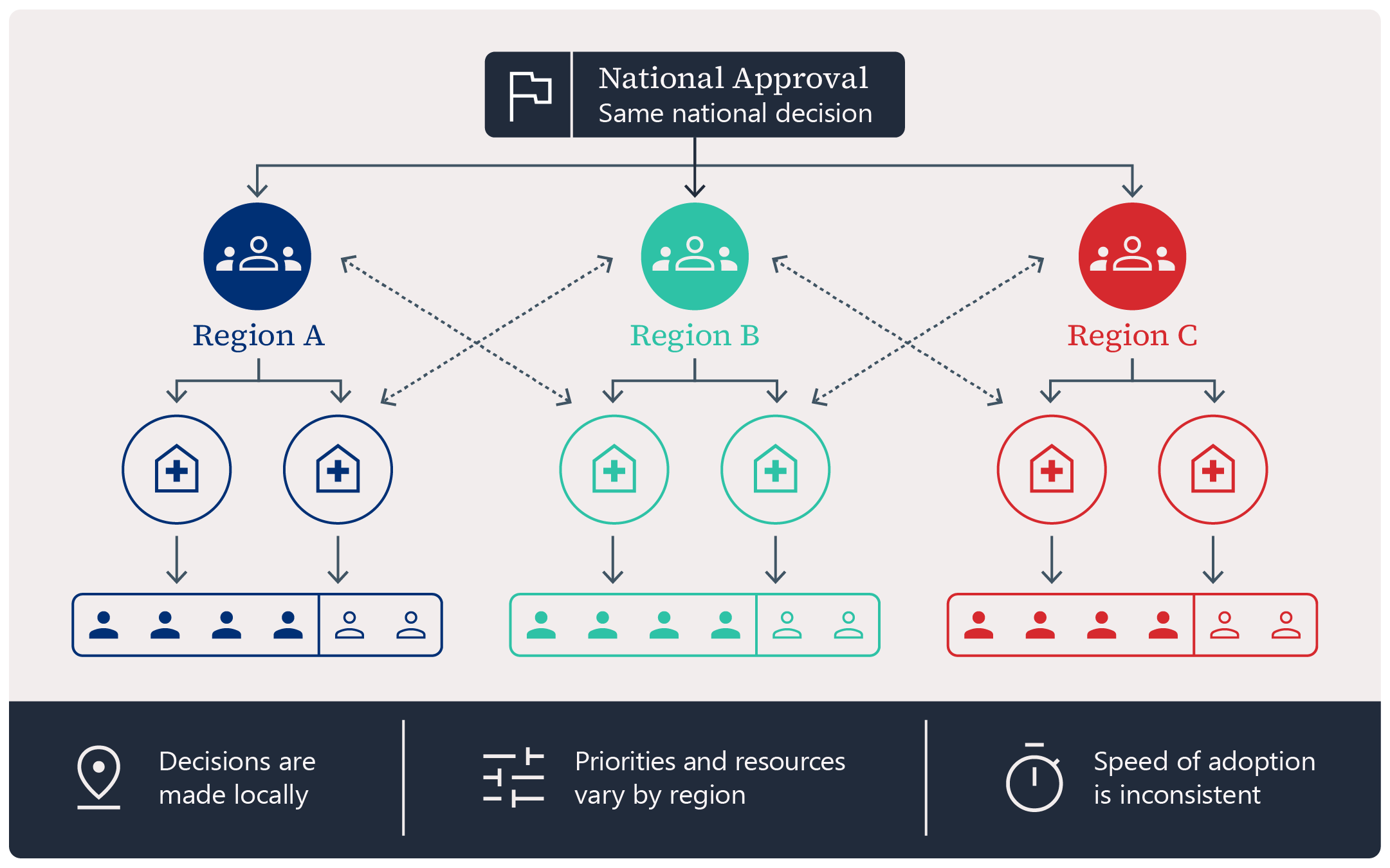
The modern complex, decentralized reality: access is local

Diagram showing how a single National Approval decision leads to inconsistent patient access across three regions (A, B, C), each with varying hospitals and patient numbers. Key takeaways: decisions are made locally, priorities and resources vary by region, and speed of adoption is inconsistent.

The rise of regional pharma market access: where access is really won

Across Europe, the most important decisions affecting uptake are no longer made in national ministries or HTA bodies. They are made in:

  • Regional payer committees
  • Hospital pharmacy and therapeutics (P&T) boards
  • Integrated care systems
  • Clinical networks
  • Procurement alliances
  • Local budget-holding entities

These bodies determine:

  • Whether a therapy is added to local formularies
  • How it is funded
  • Which patients are eligible
  • How quickly implementation occurs
  • How pathways are updated

This is why regional pharma market access has become the defining capability for modern commercial teams. It is the layer where national strategy becomes real or fails.

The ‘missing middle’: why national strategy fails in local reality

Most organizations still operate with a national-first mindset. They invest heavily in national HTA, pricing negotiations, and value dossiers. But once the national decision is secured, the strategy often collapses into generic messaging and job title based stakeholder lists.

This creates a ‘missing middle’: the gap between national success and local implementation.

Common gaps include:

  • Field teams unsure which regional bodies matter most
  • Engagement plans built around titles, rather than influence
  • Local decision-makers receiving national messages that don’t reflect their priorities
  • Slow or uneven uptake despite strong clinical value
  • Reactive firefighting instead of proactive shaping

National vs local priorities

The issue isn’t capability; it’s the operating model. Companies need a localized market access system, not a national plan with regional add-ons.

What winning looks like: A modern regional pharma market access model

To succeed in today’s environment, companies must build a structured, repeatable approach to regional and local access. The most effective organizations focus on four interconnected capabilities.

1. Health system mapping: understanding the real decision pathway

Every region has its own ecosystem: its own budget holders, influencers, clinical champions, procurement processes, and implementation barriers. National teams often underestimate how different these ecosystems can be.

Effective mapping includes:

  • Regional and hospital-level decision pathways
  • Funding flows and budget cycles
  • Local clinical priorities and unmet needs
  • Key influencers across payer, clinical, and administrative layers
  • Barriers and enablers to adoption

This is the foundation of any credible regional market access strategy. Without it, companies are flying blind.

2. Influence & investment segmentation: moving beyond job titles

Traditional segmentation assumes that titles have equal power. Influence is distributed across roles, committees, and informal networks.

A modern approach focuses on:

  • Influence: Who shapes decisions, even if they don’t sign them
  • Decision power: Who controls budgets, protocols, and pathways
  • Channel preference: How each stakeholder prefers to engage
  • Implementation impact: Who can accelerate or block adoption

This creates a segmentation model based on action and output, not hierarchy. It also helps teams prioritize accounts and contacts where effort will generate the greatest return.

3. Local value activation: tailoring the story to regional priorities

National value messages rarely resonate at the regional level. Local decision-makers care about:

  • Budget impact in their specific population
  • Operational feasibility
  • Pathway alignment
  • Local outcomes and unmet need
  • Real-world implementation challenges

Winning companies translate national value into regional pharma market access narratives that speak directly to regional priorities. They adapt evidence, tailor messages, and provide tools that help local stakeholders solve their own problems.

4. Execution excellence: empowering field teams to deliver impact

Even the best strategy fails without strong execution. Regional access requires coordinated action across medical, commercial, and market access teams.

High-performing organizations:

  • Equip field teams with actionable evidence, not static decks
  • Provide autonomy within a clear strategic framework
  • Align cross-functional teams around shared regional objectives
  • Track progress through adoption, implementation, and patient access, not just activity metrics

The 4 pillars of regional pharma market access: a connected approach to access across every region

Health system mapping

Understand the real decision pathways, stakeholders, budgets and local priorities

Influence & investment segmentation

Focus resources on the right stakeholders based on their influence and local decision power

Local value activation

Translate your value into local context, priorities and evidence that resonates

Execution excellence

Drive coordinated, measurable engagement and implementation for sustained uptake

Stronger locally with greater impact nationally

Local understanding * Targeted action * Better patient outcomes

6 practical takeaways for pharma leaders

To compete in a world where regional variation defines commercial performance, leaders should focus on these priorities:

  1. Treat regional pharma market access as a commercial growth driver, not a compliance step.
  2. Invest in dynamic regional intelligence, updated continuously, not annually.
  3. Equip field teams with localized insights, not national messaging.
  4. Prioritize accounts based on influence and implementation potential, not size alone.
  5. Align medical, commercial, and market access teams around regional execution.
  6. Measure success by real-world adoption and patient access, not national approvals.

These shifts require new capabilities, new ways of working, and a new mindset. But the payoff is significant: faster uptake, more consistent access, and stronger commercial performance.

Summary and next steps

The era of the national launch is over. The companies that win will be the ones that go local. Health systems have evolved, decision-making has decentralized, and the real battleground for access has moved to the regional and local level.

Companies that continue to rely on national-only strategies will see inconsistent uptake and missed opportunities. Those that build strong subnational market access capabilities will outperform their competitors – not because they have better products, but because they understand how decisions are made in the real world.

The future belongs to organizations that can operate with precision at the regional level. The companies that win will be the ones that implement localized market access.

Achieving success today requires scalable regional execution. Basecase value communication software enables this by providing a platform for delivering tailored, region-specific value stories and insights, helping teams execute a regional market access strategy effectively. By supporting localized market access and adapting to subnational market access needs, Basecase helps drive faster adoption and more consistent outcomes across regions.

Author

Manoj Sood

Senior consultant and capability leader – Life Sciences

A senior consultant and capability leader in life sciences, Manoj has supported global, regional, and affiliate teams across international markets. His work spans biopharmaceutical companies, health system partners, and cross‑functional commercial, medical, and market access organizations. Manoj helps these teams translate strategy into execution through capability development, omnichannel training, strategic onboarding, and narrative design. He strengthens performance, accelerates adoption, and scales impact across diverse healthcare ecosystems by equipping teams with the skills, structures, and clarity needed to deliver consistent, real‑world results.

Make an inquiry

Ready to bring your value story to life? Make an inquiry to learn how BaseCase value communication software transforms complex economic models and clinical data into interactive, field-ready tools.

Show live impact with real-time scenario updates
Show budget impacts and cost-effectiveness with live cost calculators
Adapt by audience without rebuilding models
Ensure compliant consistency across teams


FAQs

Why is regional pharma market access more important than national approval today?

National approval no longer guarantees uptake because real-world decisions increasingly happen at the subnational level. Regional pharma market access determines how therapies are funded, adopted, and implemented across health systems. With growing decentralization, subnational market access dynamics, such as regional budgets and local decision pathways, directly influence how quickly and widely patients receive new treatments.

What makes an effective regional market access strategy in decentralized health systems?

A strong regional market access strategy goes beyond national planning by incorporating localized insights, stakeholder mapping, and tailored engagement. Success depends on aligning evidence and messaging with localized market access needs, including regional priorities, funding constraints, and clinical pathways. Companies that adapt strategies at this level are better positioned to drive consistent adoption across diverse healthcare systems. Read the blog to learn best practices for pharma commercialization in market access.

How does subnational market access impact drug adoption timelines?

Even after national approval, subnational market access processes, such as regional reviews, hospital formulary decisions, and funding approvals, can significantly delay adoption. A proactive regional pharma market access approach, supported by a clear regional market access strategy, helps anticipate these barriers and accelerate implementation by aligning with local requirements earlier in the launch process.

What are the biggest challenges in implementing regional pharma market access strategies?

Implementing regional pharma market access strategies is challenging due to fragmented decision-making, limited visibility into subnational market access pathways, and inconsistent stakeholder engagement. Many teams also struggle to transition from national plans to localized market access execution. Without a clear regional market access strategy and strong coordination across functions, companies risk delayed adoption and uneven access across regions.

How can pharma companies operationalize a regional market access strategy at scale?

To scale effectively, companies must build repeatable models that integrate regional market access strategy with localized market access execution. This includes investing in data, empowering field teams, and aligning functions around subnational market access realities. A mature approach combines both regional market access strategy planning and localized market access delivery to ensure consistent outcomes across regions and healthcare systems.

Platforms like Basecase can support this by equipping teams with tailored, region-specific insights and tools that translate strategy into action. By enabling more effective stakeholder engagement and consistent execution, they help bridge the gap between national planning and subnational market access delivery. Learn more about BaseCase value communication software here