




search

August 24, 2026

After decades of working with biopharma sponsors, one pattern has remained remarkably consistent. Teams rarely come to us asking for a population PK model or an exposure response analysis. They come because an important decision is approaching, and they want to feel more confident about what to do next.

Are we studying the right dose? Do we have enough evidence to move forward? Would another study actually answer the question we care about? How will regulators view the data we have?

These are not simply scientific questions. They are decisions about timelines, investment, regulatory strategy and ultimately the patients waiting for a new therapy.

Pharmacometrics is one part of the broader Model-informed drug development, or MIDD, framework for using quantitative models and evidence to inform drug development decisions. Other approaches within MIDD include physiologically based pharmacokinetic (PBPK) modelingquantitative systems pharmacology (QSP), and model-based meta-analysis (MBMA). While these approaches can work together, this blog focuses specifically on the role pharmacometrics can play in helping teams navigate critical development decisions.

Whether the immediate milestone is a first-in-human study, dose selection, pivotal trial design, or a regulatory meeting, the conversation usually begins with the problem rather than the quantitative method that might solve it. What sponsors are really asking, in almost every one of these conversations, is whether they are about to make the right decision. My job is to help them see the evidence clearly enough to answer that for themselves.

Every development program is different, but the concerns behind these conversations are remarkably similar. Here are five that we hear again and again.

Five common sponsor concerns that pharmacometrics can address throughout drug development

“Are we bringing in pharmacometrics too early?”

We hear this question frequently, particularly from emerging biopharma companies. In most cases, the greater risk is waiting too long.

There is a persistent assumption that pharmacometrics becomes most valuable once Phase II data mature or a regulatory submission approaches. By then, however, many of the decisions that determine the quality of the evidence have already been made. These include first in human dose selection, escalation strategy, patient selection, endpoints, sampling, and the questions a study is designed to answer.

Bringing quantitative science into those conversations does not make uncertainty disappear. It makes uncertainty more visible while there is still time to do something about it. Instead of using modeling retrospectively to explain what happened, teams can use it prospectively to design studies that generate the evidence they will need for the next decision.

Oncology provides a clear example. FDA’s Project Optimus has accelerated the industry’s move away from simply identifying the maximum tolerated dose toward establishing doses and schedules that appropriately balance efficacy, safety, and tolerability. That requires teams to think about dose optimization earlier and build the evidence needed to support it.

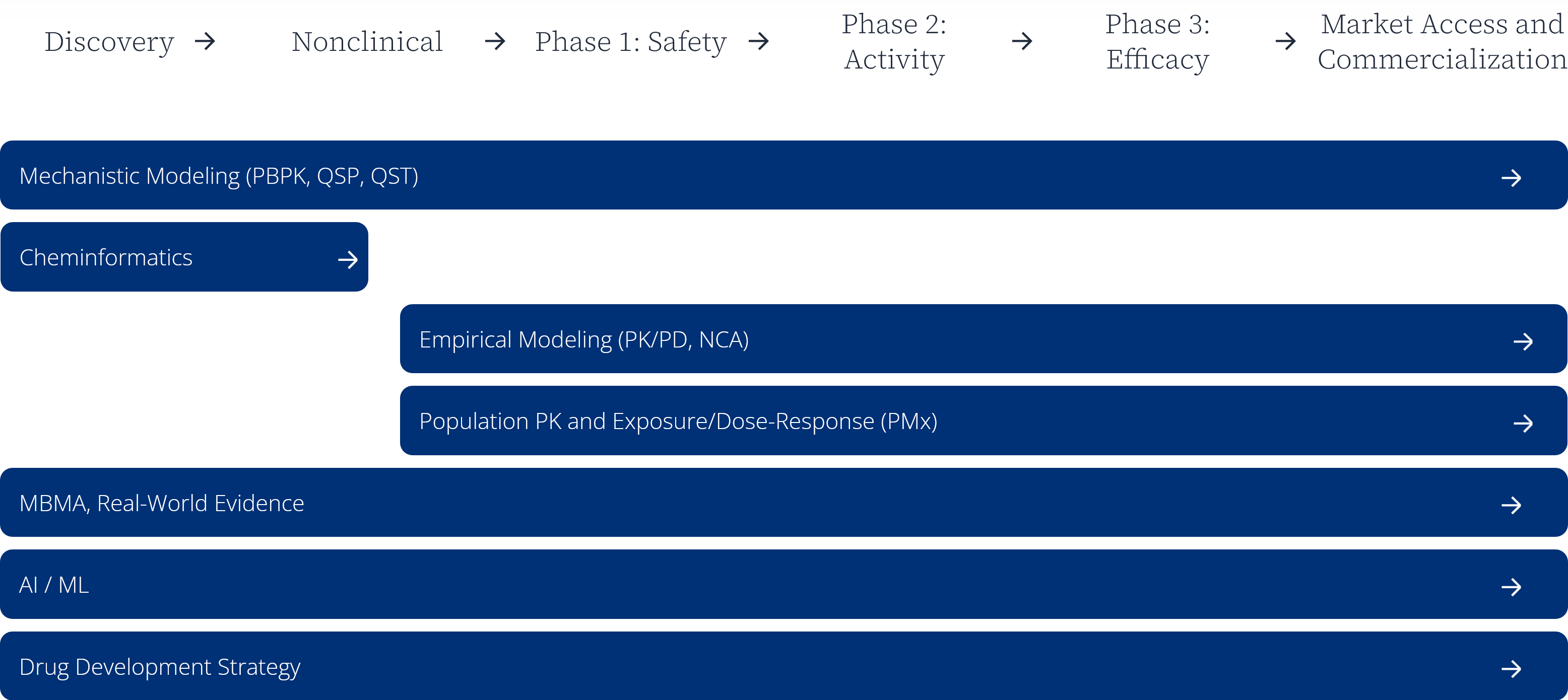
MIDD across the development lifecycle

Discovery

Nonclinical

Phase 1: Safety

Phase 2: Activity

Phase 3: Efficacy

Market Access and Commercialization

Discovery > Nonclinical > Phase 1: Safety > Phase 2: Activity > Phase 3: Efficacy > Market Access and Commercialization

Mechanistic Modeling (PBPK, QSP, QST)​

Discovery > Nonclinical

Cheminformatics​

Nonclinical > Phase 1: Safety > Phase 2: Activity > Phase 3: Efficacy > Market Access and Commercialization

Empirical Modeling (PK/PD, NCA)​

Population PK and Exposure/Dose-Response (PMx)​

Discovery > Nonclinical > Phase 1: Safety > Phase 2: Activity > Phase 3: Efficacy > Market Access and Commercialization

MBMA, Real-World Evidence​

AI / ML​

Drug Development Strategy​

“We don’t have enough data”

Almost every development team feels this at some point. Early-stage teams want Phase II data, Phase II teams want Phase III data, and even mature programs can find themselves waiting for one more study before making a consequential decision.

Drug development, however, has always required decisions before the complete picture is available. The more useful question is whether the evidence already available can reduce uncertainty enough to make the next decision.

Pharmacometrics can bring together information that might otherwise remain disconnected, including early clinical observations, preclinical data, biomarkers, exposure data, prior knowledge, published literature and an understanding of the drug’s mechanism. Each source provides part of the picture. When considered together, they can provide a much clearer understanding of how a therapy is likely to behave and where the important uncertainties remain.

This becomes particularly valuable in pediatricsrare diseases, and other settings where large clinical datasets may be difficult or impossible to generate. Integrating the evidence that already exists can help strengthen a dosing strategy, support regulatory discussions and identify which remaining questions require additional data.

The goal is not to replace clinical evidence with a model. It is to use all available evidence intelligently and determine which uncertainties matter enough to require more data. Sometimes another study is necessary. In other cases, the information needed to make the decision may already be there.

“We have to watch the budget”

Every clinical study represents substantial time, capital and opportunity cost, so budget is naturally part of the conversation. But focusing only on the cost of pharmacometrics can obscure the much larger question: What could it cost to make the wrong development decision?

A poorly selected dose carried into a pivotal trial, an unnecessary cohort, a study that does not answer the intended question or a regulatory interaction that exposes an evidence gap can carry consequences far beyond the cost of the quantitative work that might have identified the risk earlier.

This is where the conversation often changes. Could an exposure response analysis strengthen the dose rationale? Could simulation test trial design assumptions before patients are enrolled? Could existing data answer the question without another study? Could quantitative analysis identify the evidence gap that actually matters?

Instead of asking whether pharmacometrics is worth the investment, sponsors begin asking what it could cost to make an important development decision without fully understanding the evidence they already have.

“We’re not even sure what we should be asking”

Drug development has become increasingly interconnected, with clinical pharmacology, clinical development, biostatistics, regulatory strategy, safety, pediatrics, chemistry, manufacturing, and controls and other functions contributing to the same critical decisions. With so many perspectives and quantitative approaches available, knowing where to start is not always obvious.

Most sponsors do not arrive with a fully developed modeling plan, and they do not need to. The conversation often starts much more simply: Here is where our program stands. Here is what is keeping our team awake at night. If this were your program, what would you be thinking about?

Starting with the development question rather than a predetermined methodology allows the quantitative strategy to follow the evidence. Sometimes the right approach is population PK. Sometimes it is exposure response. Sometimes another MIDD approach is more appropriate. There are also situations where the best recommendation is to collect additional data before modeling anything at all.

The method should serve the decision, not the other way around.

“We already have an internal pharmacometrics team”

Many of the sponsors we work with do. One misconception about consulting is that organizations seek outside expertise because they lack internal capabilities. More often, the opposite is true. External pharmacometrics support serves as an extension of an organization’s in-house team.

Modern development programs can require multiple specialties at the same time. A complex oncology, rare disease or cell therapy program, for example, may draw on clinical pharmacology, population PK, exposure response, PBPK, QSP, regulatory strategy, and therapeutic area expertise.

Even highly capable internal teams may need additional capacity, specialized expertise, an independent perspective, or experience with a particular development or regulatory question. The strongest external partnerships complement the sponsor’s scientists and broaden the expertise available when decisions become more complex or consequential.

The conversation around pharmacometrics has changed

When I started in this field, pharmacometrics was something teams brought in ad hoc to answer one or two specific questions. Today it helps shape program strategy from the very first study. The science advanced, but what I find most striking is how central it has become to the decision itself.

The adoption of ICH M15, General Principles for Model-Informed Drug Development, reflects the broader maturation of MIDD and the increasingly structured role quantitative approaches can play in how evidence is generated, evaluated, communicated and used in decision making.

But the fundamental challenge has not changed. Development teams still have to make consequential decisions before every uncertainty has been resolved.

That is where pharmacometrics can create its greatest value. It cannot eliminate uncertainty from drug development, but it can help teams understand it, quantify it, and make better decisions with the evidence available. Often the most valuable contribution is not the analysis itself. It is helping a team ask a sharper question before they commit their next study, or their next dollar.

Questions worth asking before your next development milestone

Every program is different, but there are several questions worth considering before committing to the next study, dose, or regulatory strategy.

  • Are we evaluating the right dose or dose range?
  • Do we have enough evidence to make the next decision?
  • Would another study reduce the uncertainty that actually matters?
  • Can the data we already have answer questions we have not explored?
  • How can we strengthen our rationale before the next regulatory or development milestone?

Sometimes the most valuable outcome is not another analysis. It is identifying the right question before the next investment.

Authors

Rik de Greef

Rik de Greef

Senior Vice President, Global Quantitative Sciences Services, Certara Drug Development Solutions

Rik de Greef is a Senior VicePresident of Global Quantitative Science Services at Certara. Rik was trained as a PK-PD scientist at Leiden University, The Netherlands. Over the years, Rik has taken on roles with increasing responsibilities within Organon and its successor companies Schering-Plough and Merck/MSD.

Erika Brooks

Marketing Director, Quantitative Science Services

With over 22 years of experience in hospitals, health systems, associations, life sciences, physician practices, and suppliers, Erika is an experienced marketing strategist and supports the Quantitative Science Services offering with Go-to market planning and execution.

Frequently asked questions

What is pharmacometrics in drug development?

Pharmacometrics is a quantitative discipline used to characterize relationships among a drug, the patient, and the response to treatment. In practice, it can bring together information such as drug exposure, clinical response, patient variability, and prior knowledge to support decisions around dose selection, trial design, development strategy, and regulatory evidence.

When should a sponsor bring in pharmacometrics support?

Ideally, pharmacometrics should be considered before critical study design and dose decisions become fixed. Early involvement allows quantitative analysis to help shape the evidence a program generates rather than only interpreting that evidence after a study is complete.

How is pharmacometrics different from model informed drug development?

Model informed drug development, or MIDD, is the broader framework for using quantitative models and evidence to inform drug development decisions. Pharmacometrics is a core discipline within MIDD, alongside approaches such as PBPK, QSP, and MBMA.

Can pharmacometrics help when clinical data are limited?

Yes. This can be particularly valuable in pediatrics, rare diseases and early development, where integrating clinical observations with preclinical data, biomarkers, prior knowledge and other available evidence can help characterize uncertainty and inform the next step.

Do we still need external support if we have an internal pharmacometrics team?

Many sponsors with strong internal teams use external collaborators to add capacity, specialized expertise, therapeutic area experience, or an independent perspective around complex development decisions. The goal is to complement the internal team and expand the expertise available when needed.

Bring quantitative science into your next decision

Whether you are selecting a first-in-human dose, optimizing a development strategy, preparing for a regulatory meeting or deciding whether another study is necessary, the best place to start is with the decision you need to make and the evidence you already have.


Explore pharmacometrics servicesTalk to our experts