




search

June 26, 2026

Introduction

Medication safety during pregnancy remains a critical challenge due to limited clinical trial data and ethical considerations. Real-world evidence (RWE) is increasingly helping bridge these gaps by informing safer, more inclusive clinical trial designs. This blog explores how RWE can strengthen clinical trials involving pregnant individuals and improve decision-making across drug development.

Why pregnancy inclusion in clinical trials matters

Historically, pregnant individuals have been excluded from clinical trials, largely due to safety concerns and past tragedies such as thalidomide. However, this exclusion has created significant evidence gaps that affect treatment decisions today. Regulatory guidance, including FDA recommendations, now encourages more thoughtful inclusion where scientifically and ethically appropriate.

Including pregnant individuals requires careful consideration of factors such as optimal timing during gestation, appropriate control populations, and identification of populations most likely to benefit. These decisions can be significantly strengthened through the use of real-world evidence supported by solutions such as Certara real-world evidence services, which enable robust data analysis and evidence generation.

Inclusion of pregnancy studies during the drug development process

When can pregnant individuals be included

Discovery

Preclinical

Early clinical

Late clinical

Post-marketing

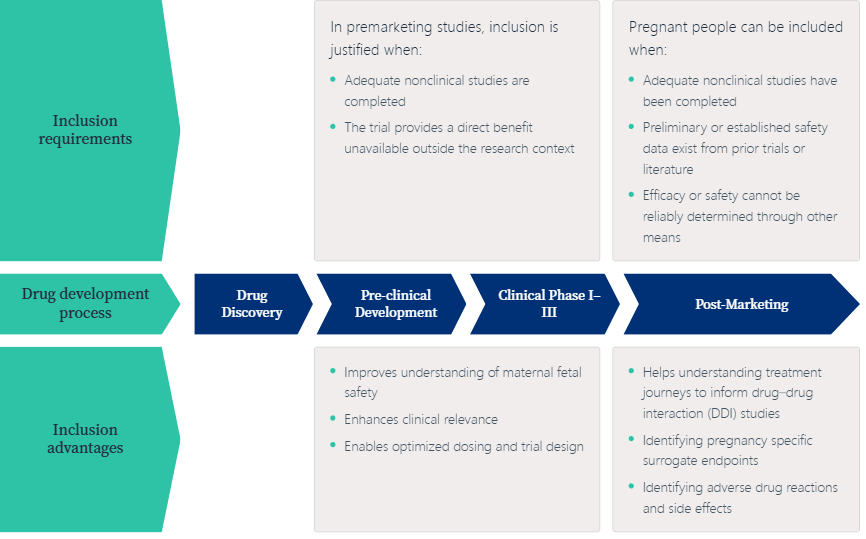
In premarketing studies, inclusion is justified when:

a) Adequate nonclinical studies are completed,
b) The trial provides a direct benefit unavailable outside the research setting.

In premarketing studies, pregnant people can be included when:

a) Adequate nonclinical studies have been completed,
b) Preliminary or established safety data exist from prior trials or literature, and
c) Efficacy or safety cannot be reliably determined through other means.

In premarketing studies, RWE:

  • Improves understanding of maternal fetal safety
  • Enhances clinical relevance
  • Enables optimized dosing and trial design

In post-marketing studies, RWE:

  • Helps understanding treatment journeys to inform drug–drug interaction (DDI) studies
  • Identifying pregnancy specific surrogate endpoints.
  • Identifying adverse drug reactions and side effects.

Premarketing studies

In premarketing settings, inclusion is considered appropriate when:

  • Adequate nonclinical data (in vitro, in vivo, animal studies) are available
  • The intervention offers direct benefit that cannot be obtained outside the trial

Post marketing studies

Most pregnancy safety data comes from post marketing RWE studies. Inclusion is justified when:

  • There is an established safety database in non-pregnant populations
  • Existing evidence is insufficient to assess safety or efficacy in pregnancy
  • Outcomes cannot be reliably extrapolated

These frameworks highlight the growing importance of RWE platforms and integrated evidence strategies, such as those offered through Certara evidence and access solutions, which combine RWE with market access and regulatory insights.

Leveraging real-world evidence to strengthen clinical trials

Improving trial design and endpoints

RWE can inform key aspects of trial design, including endpoint selection and identification of surrogate endpoints. For example, pregnancy safety studies evaluating antiseizure medications have identified outcomes such as birth weight and spontaneous abortion as meaningful endpoints. These insights can guide future trials in similar therapeutic areas.

Advanced modeling approaches, such as Certara modeling and simulation services, can further enhance trial design by simulating outcomes, optimizing dosing strategies, and improving decision-making even when data are limited.

Supporting inclusion and diversity

RWE has demonstrated that pregnant individuals are often underrepresented in trials. Reframing pregnancy as “scientifically complex” rather than “vulnerable” can encourage broader inclusion and improve diversity in research populations.

Evaluating surrogate endpoints

While regulatory agencies maintain lists of surrogate endpoints, these are not always validated for pregnancy populations. RWE can help assess their relevance and applicability, improving trial reliability.

Using real-world data to understand patient populations

RWE provides valuable insights into:

  • Disease incidence and prevalence in pregnancy
  • High-risk populations
  • Maternal characteristics and comorbidities
  • Real-world treatment pathways

These insights help define more accurate inclusion and exclusion criteria, ensuring trials reflect real clinical scenarios.

Additionally, understanding treatment journeys allows researchers to evaluate concomitant medications and potential drug-drug interactions, which is especially important in pregnancy studies. Combining RWE with predictive tools from Certara’s broader drug development solutions portfolio enables a more comprehensive, data-driven approach across development stages. The role of RWE in advancing pregnancy research

The COVID-19 pandemic underscored the risks of excluding pregnant individuals from research. Higher ICU admission rates among pregnant women highlighted the need for better data, ultimately leading to their inclusion in vaccine trials.

RWE played a key role in identifying these risks and supporting more inclusive research approaches. This shift demonstrates how real-world data can accelerate evidence generation in urgent scenarios.

Conclusion

The exclusion of pregnant individuals from clinical trials has created long-standing evidence gaps that impact patient care. Real-world evidence offers a practical and ethical way to complement traditional clinical trials by providing insights from real-life settings.

Integrating RWE into pregnancy research enables more inclusive, accurate, and meaningful evidence generation. As the industry continues to evolve, leveraging RWE will be essential to ensuring that treatment decisions reflect the needs of all patient populations.

Author

Alekhya Lavu, PhD, PharmD

Technical Consultant, Evidence & Access

Alekhya Lavu is an epidemiologist at Certara within the Real-World Evidence & Modelling Solutions team, with over seven years of experience in real-world evidence (RWE) generation and synthesis using real-world data (RWD). She holds a Doctor of Pharmacy degree from Manipal university and a PhD in Pharmacoepidemiology from the University of Manitoba, Canada. Her work focuses on RWE generation and synthesis. She has extensive experience working with administrative healthcare databases, including claims and electronic medical records (EMR), and provides expertise in feasibility assessments and the selection of fit-for-purpose data sources across North America and Europe, with particular specialization in Canadian administrative health databases. She has authored over 19 peer-reviewed publications, contributed to more than 35 conference abstracts, and presented her work at national and international conferences.

Transform drug development with data-driven insights

Learn how Certara’s modeling and simulation and real-world data capabilities can accelerate your clinical programs.

Explore modeling and simulation servicesDiscover evidence and access solutions

FAQs

Why is real-world evidence important in pregnancy research?

RWE helps fill gaps left by traditional clinical trials by providing insights into safety and effectiveness in real-life settings, especially for populations often excluded from trials.

Can pregnant individuals safely participate in clinical trials?

Yes, under specific conditions where sufficient prior data exists and when the trial offers potential benefit or cannot be conducted otherwise.

How does RWE improve clinical trial design?

It informs endpoint selection, patient population identification, and study feasibility based on real-world patient data.

What are surrogate endpoints and why are they important?

It informs endpoint selection, patient population identification, and study feasibility based on real-world patient data.Surrogate endpoints are indirect measures of treatment effect. RWE helps validate whether these endpoints are appropriate for pregnant populations.

Contact us

Certara’s team of experts is ready to help you navigate the design and execution of real-world data studies aimed to support peri- and post-approval discussions with stakeholders. 

Trusted partner in pharmaceutical innovation
Decades of experience in data-driven solutions
Proven success in regulatory and market access strategies