



Sessions:
Thursday, September 17, 2026 | 10:00 – 11:00 AM ET
Friday, September 18, 2026 | 10:00 – 11:00 AM JST
Friday, September 18, 2026 | 10:00 – 11:00 AM CEST
Products: Certara.AI , Chemaxon®, CoAuthor™
Summary
Your teams understand the science. What they don’t have is a straight line from question to answer. The reason is development’s outdated “operating system.” Data lives in disconnected systems, so that every new analysis triggers a new integration project. AI pilots stall because outputs can’t be reproduced, audited, or defended in a regulatory submission. And the manual handoffs between discovery, clinical, and regulatory compound the cost of every delay.
Today, drug development gets a new OS. Certara NEXUS™ is Certara’s integrated platform for efficient drug discovery, development, and submission — bringing Certara’s applications, your data, and governed agentic AI into one connected environment. By orchestrating tool collaboration across your workflows, teams work from a single source of scientific truth, from discovery to submission.
Join us for the public debut of Certara NEXUS, where our leadership team will walk through the platform, explore use cases, and show how scientific and business leaders are already moving from siloed processes to connected, repeatable execution — with the traceability regulators require.
Register now

James Blauvelt
Director, AI and Data Sciences, CertaraJames Blauvelt is Director, AI and Data Sciences at Certara, where he builds and leads the data science and machine learning engineering teams behind Certara’s AI platform. A driven, curious leader in data science and generative AI, James has more than a decade of experience leading high-velocity teams and developing natural language processing and other deep learning systems. Prior to Certara, he built scalable deep learning and NLP systems at Vyasa Analytics until its acquisition by Certara. James holds a Master of Science in Data Science and Analytics from the University of New Hampshire and resides in Dover, New Hampshire.

Nick Brown
Director, Global Portfolio Leader for Certara.AINick Brown is Director, Global Portfolio Leader for Certara.AI; the life sciences-specialized GPT platform. Nick has over 10 years of experience driving AI adoption and customer success across life sciences, federal government and other industries. Prior to Certara, Nick led marketing at Vyasa (now Certara.AI) assisting in the launch and go-to-market strategy for the Layar data platform. He is a graduate of the University of New Hampshire and resides in Andover, MA.
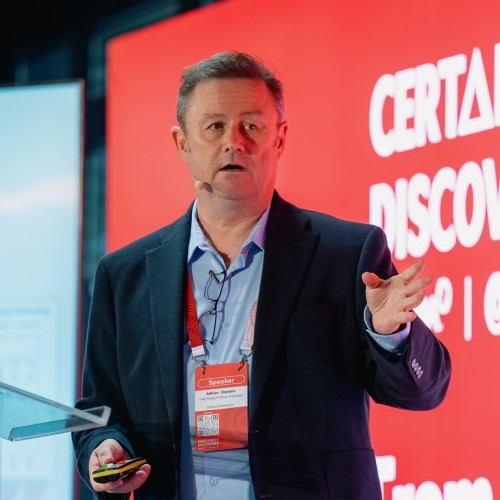
Adrian Stevens
Chief Product Officer, ChemaxonAdrian Stevens joined Chemaxon as Chief Product Officer in 2022. Adrian has spent approximately 15 years working in Life Sciences software companies, in product management roles for most of his time. As a computational chemist at BioFocus PLC, over the course of nearly 10 years, he supported a wide range of areas in therapeutic research, from oncology, metabolic diseases, autoimmune and pain-based medicines. Adrian has a PhD in Computational Chemistry from the University of Portsmouth.
Register now