



search

RADNOR, PA – June 12, 2026 – Certara, Inc. (Nasdaq: CERT), a global leader in model-informed drug development, today announced the integration of its D360 scientific informatics platform with its Secondary Intelligence quantitative systems toxicology software to enable more efficient and comprehensive off-target pharmacology risk profiling of investigational drugs. Safety issues account for approximately 25% of drug project attrition, often due to secondary pharmacology challenges.

“Integrating Secondary Intelligence with D360 enables scientists to bring together high-quality pharmacological data and advanced analytics in a unified environment, helping them predict the likelihood of hitting each of a set of off-target receptors at the selected plasma concentration,” said Will Redfern, Vice President, Quantitative Systems Toxicology and Safety at Certara.

“This first step in integrating more advanced pharmacology capabilities with D360 allows medicinal chemists to preferentially select substances with reduced off-target risk to improve downstream success rates from a much earlier research stage” added David Lowis, Executive Director of Scientific Informatics, D360 at Certara.

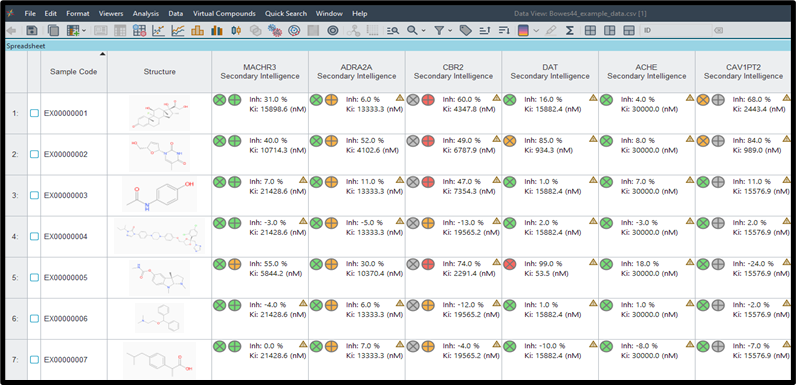
Screenshot of the D360 scientific informatics platform displaying Secondary Intelligence off-target pharmacology data. Rows represent investigational drug compounds; columns represent off-target receptors. Each cell shows inhibition percentage and Ki value alongside a color-coded circle indicating low (green), medium (amber), high (red), or unplotted (grey) likelihood of receptor engagement at the entered unbound plasma concentration.

Figure 1. Each row is a compound; each column an off-target receptor.  = Negative modulation;  = positive modulation. The colour of the circle indicates the relative likelihood of engagement with that receptor at the unbound plasma concentration entered, based on reference drugs with clinical data (green: LOW; amber: MEDIUM; red: HIGH; grey: no plottable reference drugs exist).

The D360 Scientific Informatics Platform is the industry-leading solution for small molecule and sequence-based modalities research. D360’s versatility and low total cost of ownership have made it the analysis and visualization system of choice for discovery teams globally. Designed to empower scientists, D360 offers seamless access to enterprise data — from compound informatics and bioactivity parameters to operational data like inventory — along with integrated tools for visualization, analysis, and collaboration.

Intelligence is part of Certara’s growing predictive drug safety toolbox, ToxStudio®, which also includes:

  • Cardiac Safety Simulator, which predicts a drug’s likelihood of QT prolongation
  • Libra ™, AI-powered software that predicts the likelihood of drug-induced liver injury

ToxStudio is also part of Certara’s Non-Animal Navigator™ solution which helps sponsors reduce reliance on animal studies in favor of new approach methodologies (NAMs). The Non-Animal Navigator solution is designed to facilitate sponsors complying with the recommendations made in the FDA’s report, “Reducing Animal Testing in Nonclinical Studies.”

Secondary Intelligence can be purchased as a standalone product or integrated with D360.

Learn more about Certara’s solutions for safety assessment and scientific informatics: https://www.certara.com/fact-sheet/add-off-target-risk-profiling-to-your-analyses/


About Certara

Certara accelerates medicines using biosimulation software, technology, and services to transform traditional drug discovery and development. Its clients include more than 2,600 biopharmaceutical companies, academic institutions, and regulatory agencies across 70 countries. Learn more at certara.com.

Certara contact:

Sheila Rocchio
[email protected]

Safety First: Uncovering the Clinical Risks Inside Your Compound Screening Data

For toxicologists and safety pharmacologists, in vitro data offer an early warning of clinical hazards. How can we extract the most actionable intelligence from these data? In this webinar, our experts explain how scientists can contextualize secondary pharmacology data for safety insights.


Watch the webinar