




search

Drug Interaction Database (DIDB®)

The industry’s largest scientist-curated database for assessing drug interactions and safety

Concomitant Meds Navigator

Now available

Evidence-based drug-drug interaction assessment

The Drug Interaction Database (DIDB®) is the industry’s most comprehensive resource for evaluating drug-drug interactions (DDIs), providing access to qualitative and quantitative human in vitro and clinical data. DIDB® is curated daily by research scientists with extensive expertise in DDIs and pharmacogenetics to ensure accurate, up-to-date information.

DIDB® incorporates intrinsic and extrinsic factors, including co-medications, excipients, food and natural products, organ impairment, and genetics to support the evaluation of pharmacokinetic (PK)-based drug interactions and safety. Its user-friendly interface and pre-formulated queries enable efficient access to comprehensive DDI information.

Quickly calculate DDI risk
Prioritize and design clinical trials
Support drug labeling recommendations
Identify interacting concomitant medications
Access expansive, up-to-date information from scientific publications and regulatory documentation

Advancing drug interaction science

100
Publications and NDA/BLA packages analyzed monthly
200
pharmaceutical and biotech companies worldwide trust DIDB
210,000
entries and counting

Explore DIDB’s dynamic research tools and applications

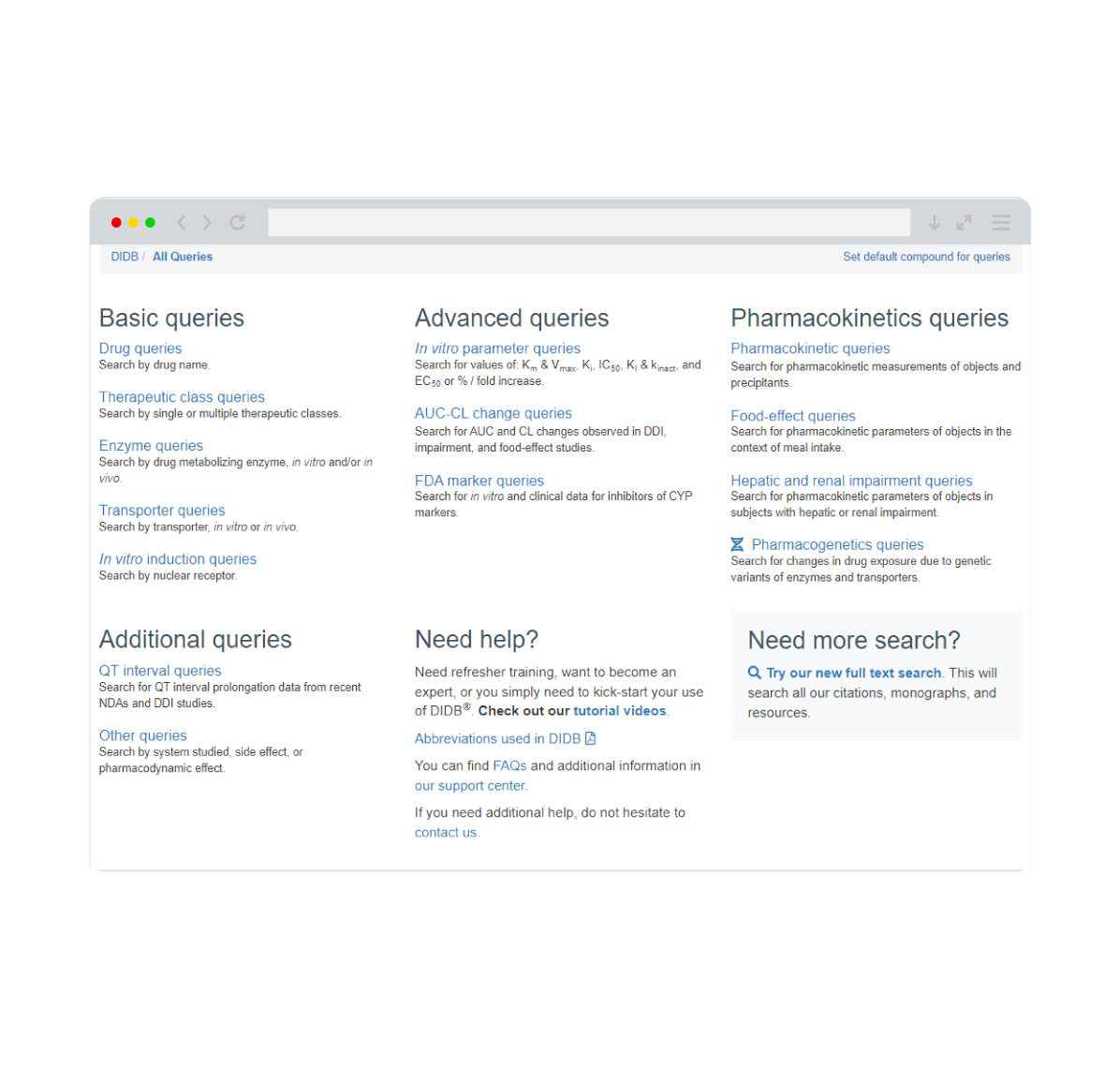
Retrieve DDI information with 70+ pre-formulated queries

Search the DIDB using multiple query options.

Easily filter query for metadata analysis

Perform metadata analysis of quantitative results using common metrics across all studies.

Explore in-depth drug monographs

Review mechanistic and quantitative findings such as PK profile, DDI summary, and QT summary, as well as overall DDI risk level and label recommendations for clinical use.

Support static predictions and PBPK modeling

Use query results to guide input parameter selection and provide context for results obtained for candidate compounds.

Quickly calculate clinical DDI risk

Explore the clinical DDI risk of a compound acting as a precipitant or perpetrator based on a compound’s properties and early in vitro results using with the drug-drug interaction (DDI) calculator.

Support personalized medicine approaches with custom extracts

Leverage DIDB® to create custom extracts that support tailored therapeutic approaches for individual patients.

Quickly identify relevant concomitant medications

Generate lists of relevant medications based on enzyme and transporter characteristics with the Concomitant Meds Navigator.

Drug-drug Interaction Calculator

Mechanistic enzyme and transporter DDI assessment

  • Evaluate enzyme reversible inhibition, time-dependent inhibition, induction, and transporter inhibition
  • Apply basic and mechanistic static models to predict AUCR and net interaction effects
  • Assess combined hepatic and intestinal contributions to DDI risk
View case study

Regulatory-aligned calculations

  • Implement equations and thresholds from ICH M12 and global regulatory guidance (FDA, EMA, PMDA, NMPA)
  • Use standardized system parameters (e.g., enzyme turnover, blood flow) for consistency
  • Ensure alignment with expectations for DDI risk assessment and regulatory submissions
View fact sheet

Automated, submission-ready reporting

  • Perform real-time calculations with immediate pass/fail risk indicators
  • Generate structured PDF reports with inputs, outputs, and supporting notes
  • Maintain full transparency with linked equations referenced from guidelines and auto-generated footnotes
View video

Why choose DIDB

Why choose DIDB

Certara’s DIDB is the largest scientist-curated collection of human in vitro and clinical data available to assess drug interactions and safety.

  • 27,000+ citations from all relevant publications and FDA regulatory documents
  • 630+ NDA/BLA packages available with new approvals added monthly
Drug interactions

“DIDB is an amazing resource. It streamlines our research of pharmacokinetic parameters for individual drugs and has cut down our time to evaluate a medication by at least 50%. The team there is responsive to questions, and they have a nice training program to orient you to the tool. The ability to filter drug data in a seemingly infinite number of ways is a key feature.”

Senior Vice President of Medical AffairsPharmacogenetics and Personalized Medicine Service Provider, USA

“The DIDB is a precious tool for clinical pharmacologists; it is of invaluable help for drug-drug interactions, but there is much more with all the available resources, monographs, and information on PK effects of hepatic and renal impairment, side and pharmacodynamic effects.”

Senior DirectorBiosimulation Services Provider, Italy

“We are using online searches in DIDB for robust planning and upfront modeling of in vitro experiments, e.g., for optimizing choices of DME phenotyping inhibitors. The fast and sophisticated access to the complete in vitro dataset, available from the scientific community, facilitates the design of such in vitro studies tremendously.”

Associate Director, Senior DMPK ExpertPreclinical Service Provider, Germany

Schedule a demo or request a free trial

Discover how DIDB® can transform your drug development process. Schedule a demo or request a free trial today to explore its advanced features and capabilities.

Access the industry’s largest scientist-curated drug interaction database.
Retrieve and analyze data with over 70 pre-formulated queries.
Explore in-depth drug monographs.

FAQs

What is DIDB?

DIDB is the world’s largest scientist-curated database for evaluating drug interactions, used by over 200 pharmaceutical and biotech companies.

What type of information is included in DIDB?

DIDB includes both qualitative and quantitative human in vitro and clinical information related to various extrinsic and intrinsic factors. These include interacting co-medications, excipients, food products, herbals, tobacco, organ impairment, and genetics, that can affect drug exposure in humans.

How often is DIDB updated?

DIDB is updated daily by a team of expert scientists to ensure accuracy and relevance.

What are the main mechanisms of DDI covered in DIDB?

DIDB includes mainly metabolism- and transporter-based pharmacokinetic interactions. However, other mechanisms (e.g. absorption-based DDIs, pharmacogenetics, food effects, hepatic and renal impairment) are also covered. Pharmacodynamic interactions which cannot be explained by changes in drug or metabolite exposure are not included.

Can DIDB support personalized medicine?

Yes, DIDB enables the creation of custom extracts to support personalized therapeutic approaches.