Your Guide to Modernizing Non-Compartmental Analysis (NCA) Workflows

GUIDE
The Top 10 Things You Need to Know About Analysis Dataset Model for Non-Compartmental Analysis (ADNCA)

Why NCA Needs a Modern Approach
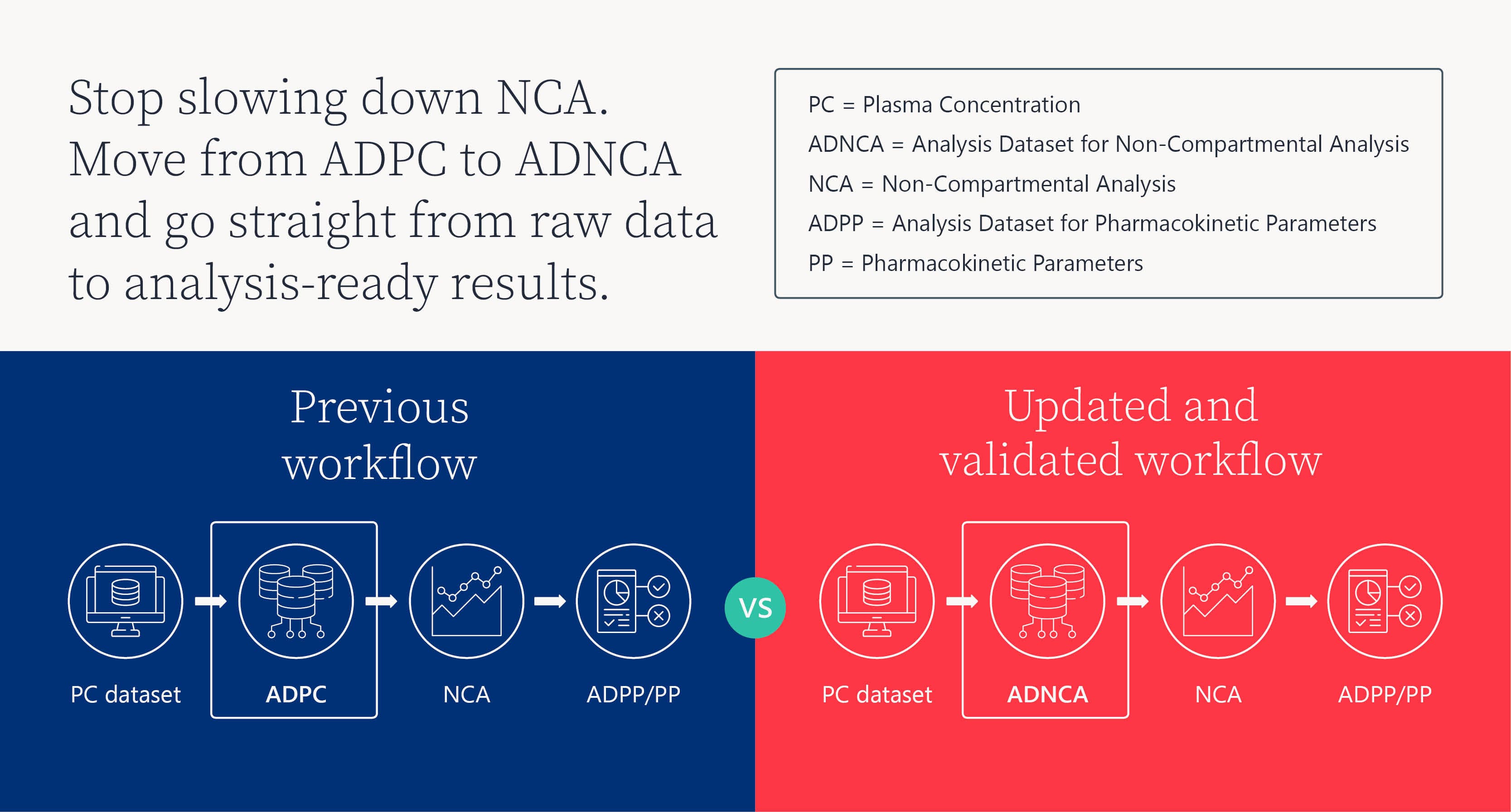
See how ADNCA removes steps and accelerates NCA workflows
When regulatory deadlines are tight, delays in pharmacokinetic (PK) data preparation can derail submissions and shorten valuable patent life. Traditional NCA workflows that used to feel fast and flexible are now slowed by manual formatting, inconsistent variable handling, and rework that leads to avoidable queries and extends submission timelines.
The Analysis Dataset Model for Non-Compartmental Analysis (ADNCA) is a formal CDISC ADaM data standard that streamlines workflows, strengthens compliance, and ensures submission-ready PK datasets.
In this guide, you’ll discover the Top 10 Things You Need to Know About ADNCA including expert tips from leading PK scientists to modernize workflows, accelerate submissions, and build regulatory confidence.
What You’ll Learn

Build regulatory confidence by aligning with FDA, PMDA, and CDISC expectations.
Future-proof submissions as ADNCA adoption grows among global regulators.
Standardize workflows with 50+ validated NCA-related variables.
Integrate seamlessly with Phoenix WinNonlin™️ for interim and final analyses.
Automate reproducibly with variables like MRRLT and TRTRINT.
Collaborate effectively with CROs and partners through harmonized datasets.
Simplify validation in Pinnacle 21 Enterprise.
Reduce reviewer burden with faster replication and fewer information requests.
Download the guide
Download the Guide & Streamline Your NCA Workflows
About our experts

Jeffrey Abolafia
Director, Product Innovation
Jeff Abolafia is currently Director of Product Innovation at Pinnacle 21 and supports multiple offices at the FDA. Previously Jeff held the position of Chief Strategist of Data Standards and was a member of the faculty in the Department of Biostatistics at the University of North Carolina. Jeff has been involved with public health research and data standards for over thirty years. Jeff co-founded the RTP CDISC User’s Group and is a member of the CDISC ADaM and Analysis Results teams and several PHUSE Real World Evidence working groups. His areas of interest include real world evidence, mobile health, data standards, regulatory submissions, and bioinformatics.

Alexia Di Quinzio, MSc
Scientist, Pharmacokinetics
Alexia Di Quinzio, MSc brings a unique blend of scientific rigor and business insight, shaped by experience across both scientific and investment roles in the life sciences sector. At Certara, she supports regulatory and clinical strategies through pharmacokinetic (PK) analyses such as non-compartmental analysis (NCA), dose proportionality, and bioequivalence, contributing to high-quality, submission-ready deliverables.
Before joining Certara, Alexia spent over three years at AmorChem, a Montreal-based venture capital fund, where she evaluated early-stage academic innovations for investment. Her work included scientific due diligence, intellectual property analysis, market assessment, and strategic support for portfolio companies. Earlier in her career, she held roles in GMP operations at Pharmascience Inc., where she contributed to quality system improvements and compliance training initiatives.
Alexia holds a Master of Science in Drug Development from the University of Montreal.
Download the guide
About Certara
Certara is dedicated to transforming drug discovery and development for good. We harness the power of biosimulation, advanced analytics, and regulatory expertise to create a future where treatments reach patients faster and more efficiently.
From discovery to market access and commercial, we tailor solutions to meet our clients’ most pressing challenges. Through strategic leadership and advanced predictive technologies, Certara provides comprehensive solutions to optimize drug development processes, reduce risks, and improve outcomes. Our clients include more than 2,400 biopharmaceutical companies, academic institutions, and regulatory agencies across 70 countries.
© 2025 Certara. All Rights Reserved. | Privacy policy