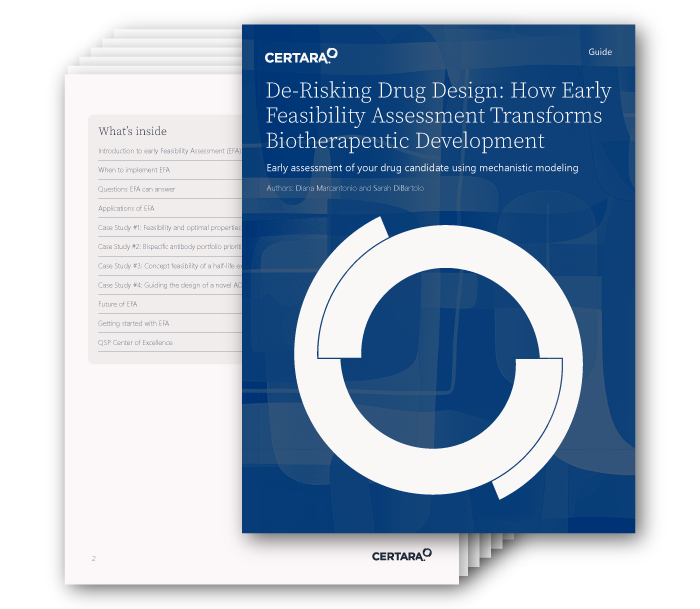
GUIDE

De-Risking Drug Design: How Early Feasibility Assessment Transforms Biotherapeutic Development

Build a strong foundation for early drug development success

Drug development is costly, complex, and risky. Despite years of investment, many candidates fail late in the process, often because dosing requirements and risks to concept feasibility were not recognized early enough. These failures consume significant financial resources that could have been directed to progressing more viable therapeutics.

Early Feasibility Assessment (EFA) helps address this challenge. By leveraging Quantitative Systems Pharmacology (QSP) models built from first principles and parameterized using literature data, EFA allows development teams to simulate human-relevant biology, predict clinical dosing, and guide go/no-go decisions—well before clinical trials begin.

With the growing number of QSP submissions to the FDA, early feasibility assessment studies are becoming a standard practice in modern drug development.


What’s inside the guide

This comprehensive guide introduces the concept of Early Feasibility Assessment (EFA) and demonstrates its real-world applications through four detailed case studies, including:

  • Bispecific antibody design: Learn how EFA helps identify affinity thresholds and design properties that improve therapeutic index.
  • Portfolio prioritization: See how modeling across multiple target combinations can streamline drug candidate selection.
  • Half-life extension strategies: Understand how EFA predicts whether modifications will enable less frequent dosing without compromising efficacy.
  • Antibody–drug conjugate (ADC) design: Discover how EFA can pinpoint key linker–payload properties that drive therapeutic index and focus resources on the most promising designs.

Each example shows how mechanistic modeling reduces uncertainty, accelerates discovery, and saves years of development time.

Download the guide

Simply fill out the form and download the expert-led guide for free!

Key learnings:

By downloading this guide, you’ll learn how to:

Apply early feasibility assessment to predict dosing and feasibility before preclinical or clinical investment.
Use mechanistic QSP modeling to de-risk drug design decisions across antibodies, bispecifics, and ADCs.
Integrate EFA workflows into discovery pipelines to shorten development timelines and improve go/no-go decision confidence.
Understand how regulators, including the FDA, increasingly support model-informed drug development strategies.

About the authors

Sarah DiBartolo, PhD

Associate Principal Scientist, QSP

With 10+ years experience, Sarah’s expertise in QSP modeling spans the entire drug development pipeline, from early feasibility assessment to clinical and post-market analyses, with a focus on Alzheimer’s Disease.

Diana Marcantonio, PhD

Senior Director, QSP

She has 20+ years of experience, including 10+ years in pharmaceutical and biotech industries, with a background in biological engineering. In her current role, she is responsible for guiding strategy and providing biological and disease area expertise on modeling projects to help clients make informed decisions during drug R&D. Prior to joining Certara, she worked in drug discovery research, where she led cross-disciplinary project teams from target identification through lead selection.

About Certara

Certara is dedicated to transforming drug discovery and development for good. We harness the power of biosimulation, advanced analytics, and regulatory expertise to create a future where treatments reach patients faster and more efficiently.

From discovery to market access and commercial, we tailor solutions to meet our clients’ most pressing challenges. Through strategic leadership and advanced predictive technologies, Certara provides comprehensive solutions to optimize drug development processes, reduce risks, and improve outcomes. Our clients include more than 2,400 biopharmaceutical companies, academic institutions, and regulatory agencies across 70 countries.

© 2025 Certara. All Rights Reserved. | Privacy policy